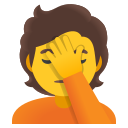
The facepalm emoji 🤦 means secondhand embarrassment or exasperated disbelief — "I can't believe you just said that." It is usually affectionate teasing, not real anger.
U+1F926
Facepalm Emoji 🤦
Person Facepalming • U+1F926 • Unicode 9.0
Facepalm emoji 🤦 shows a person covering their face with one hand. It means exasperation, disbelief or secondhand embarrassment — reacting to something dumb, obvious or cringe, usually in a joking way rather than an angry one.
✍️ Written & reviewed against real usage · verified Unicode 16.0
Tap to copy · pastes in WhatsApp, Instagram, anywhere
Facepalm emojis to copy & paste
These are the real emoji characters — tap one to copy it, then paste anywhere. Because they’re text, they show up as emoji wherever you send them.
Facepalm & related emojis
Facepalm combos
What the facepalm emoji means
🤦 is the emoji version of the classic hand-meets-forehead reaction. It lands somewhere between a laugh and a sigh: the sender thinks what just happened was obvious, avoidable or mildly ridiculous, and they are performing that reaction rather than actually being upset. Sent about a third party ("he texted her again 🤦") it is gossip-flavoured disbelief. Sent about the sender ("I locked my keys in the car 🤦") it is self-deprecation and an invitation to laugh along. Sent at you right after something you said, it is a soft callout — you missed something everyone else saw. The base yellow 🤦 reads neutral and universal, while the gendered variants 🤦♀️ and 🤦♂️ carry slightly more theatrical, "I am personally suffering" energy. The tone stays light because it is a comedy gesture, but sent alone with no words it can read as genuinely done with the conversation. The message right before it decides whether it is a joke or a sigh.
💬
In texts
A reaction to something obvious or dumb — "you already told me this 🤦". Teasing, not angry, and usually expects a laugh back.
📱
In DMs and gossip
Used about a third person: "she went back to him 🤦". Signals shared disbelief and invites the other person to keep spilling.
🎵
On TikTok and Reels
Comment-section shorthand for secondhand embarrassment at the video — the "why would you do that" reaction, often stacked with 😭 or 💀.
🙋
About yourself
A self-roast after a mistake — "replied all 🤦". It softens the confession and turns it into a joke before anyone else can.
Q. What does 🤦 mean from a girl or guy?
From a girl, 🤦 is almost always playful exasperation, not anger. If she sends it after a bad joke or a pun, she is amused and pretending not to be — that is teasing, flirt-adjacent territory. If she sends it about someone else, she is bonding with you over the gossip. The one version to read further is 🤦 alone, with no words, right after you explained yourself: that can mean she is tired of repeating herself. Quick test — if the thread is chatty and fast, it is a laugh; if replies have gone short and slow, it is a sigh.
How 🤦 looks on every platform
It’s the same character everywhere — each platform just draws it in its own style. Here are three open emoji sets side by side, plus how your own device renders it:
🤦
Your device
Twitter / X
Google (Noto)
OpenMoji
Platform
How it differs
Apple
Yellow figure with one hand flat across the forehead, eyes hidden — reads clearly as exasperation.
Google
Similar flat-hand-to-forehead pose with a more downcast head tilt, so it feels a touch more defeated.
Samsung
Rounder head and softer hand placement, which can look more like shielding the eyes than frustration.
WhatsApp
Close to Apple's design; the gendered 🤦♀️ and 🤦♂️ variants render distinctly and get used more than the base.
X and Telegram
Flat Twemoji-style art with a smaller hand, so at tiny text sizes it can be mistaken for 😑 at a glance.
Apple, Samsung and WhatsApp draw their own proprietary versions, which we don’t redistribute — the notes above describe how they differ. Open sets shown under their licences: Twemoji (CC-BY 4.0), Noto Emoji (Apache 2.0), OpenMoji (CC BY-SA 4.0).
When 🤦 does not land
The facepalm emoji 🤦 is not always read the way you intend it. These three situations change what 🤦 signals, and knowing them keeps you from sending the wrong message.
It reads as mocking if the other person is genuinely upset — a facepalm at real distress feels dismissive, not funny.
Aimed at a stranger, a boss or a client it comes off condescending, because it says "you missed the obvious" with nothing to soften it.
Sent alone with no words and no follow-up it loses the joke and can read as real annoyance or the end of the conversation.
Frequently asked
Quick answers to what people ask most about the facepalm emoji 🤦 — what it means in a text, who tends to send it, and how to copy it onto your own keyboard.
What does the 🤦 emoji mean?
It means exasperation or disbelief — the classic hand-to-forehead facepalm. Someone said or did something obvious, silly or cringeworthy, and the sender is reacting with a mix of amusement and mild despair.
Is the facepalm emoji rude?
Usually not. Among friends it is affectionate teasing. It turns rude when aimed at someone who is genuinely upset, or used in a work or formal context, where it reads as talking down to the person.
What does 🤦 mean from a girl?
Most often playful exasperation at a joke or a mistake, which is closer to flirting than criticism. If it arrives alone after a serious explanation and her replies have slowed down, it can mean real frustration.
What is the difference between 🤦 and 🤷?
🤦 is "I cannot believe that happened" — disbelief at something dumb. 🤷 is "I do not know" or "not my problem" — indifference or having no answer. Facepalm reacts; shrug declines to react.
What is the shortcode for the facepalm emoji?
The standard shortcode is :face_palm: on Slack and most platforms, with :facepalm: also widely accepted. The gendered versions are :woman_facepalming: and :man_facepalming:.
When was the facepalm emoji added?
It was approved in Unicode 9.0 and released as part of Emoji 3.0 in 2016, with the codepoint U+1F926. The woman and man versions are built from that base plus a gender sign joined by a zero-width joiner.
Related emoji guides
If 🤦 came up in a conversation, these are the emoji people most often look up next — each one explained the same way, with meanings you can actually use and characters you can copy.