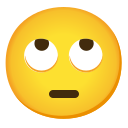
🙄 is the eye roll emoji (Face with Rolling Eyes). It means annoyance, sarcasm, disbelief or playful exasperation — the visual version of "oh my god, seriously?" Between friends it is usually affectionate teasing, not real anger.
U+1F644
Eye Roll Emoji 🙄
Face with Rolling Eyes — annoyance, sarcasm and the classic "seriously?" reaction
The eye roll emoji 🙄 means annoyance, sarcasm or disbelief. Senders use it to signal they are unimpressed by what someone said or did — often playfully, as fond exasperation with a friend or partner, rather than genuine anger in most texts.
✍️ Written & reviewed against real usage · verified Unicode 16.0
Tap to copy · pastes in WhatsApp, Instagram, anywhere
Eye Roll emojis to copy & paste
These are the real emoji characters — tap one to copy it, then paste anywhere. Because they’re text, they show up as emoji wherever you send them.
Eye Roll & related emojis
Eye Roll combos
What the eye roll emoji means
🙄 shows a yellow face with its pupils rolled up and away and the mouth flat. Unicode calls it Face with Rolling Eyes, and it landed in Unicode 8.0 back in 2015. In real messaging it almost never means literal eye movement — it is a tone marker. People attach 🙄 to a sentence to say "I am not impressed by this" without spelling it out. The intensity is completely context-dependent: after a friend's terrible pun it reads as warm teasing, but after someone cancels plans for the third time it reads as genuinely cold. That ambiguity is exactly why it is so heavily used and so heavily misread. Three buckets cover most sends. Playful exasperation — "you're so annoying 🙄" to someone you actually like. Sarcasm flag — you said something obviously untrue or over the top, and 🙄 tells the reader not to take it straight. Real irritation — usually short, alone, or replacing a reply entirely, which is the version that stings. A standalone 🙄 with no words is the strongest form and is widely read as dismissive. Note that on every major platform the eyes roll upward, which is why it reads as "whatever" rather than as flirty or shy. If you want the softer, sulkier version people reach for 😒 instead, and for full disbelief at someone's stupidity 🤦 does the job better.
💬
In texts
Softens or sharpens a complaint. "fine, I'll do it 🙄" reads as playful grumbling; a bare 🙄 with no words reads as genuinely dismissive. Message length is the tell.
💌
In DMs and flirting
Very common as fond exasperation: "stopppp 🙄" after a compliment means they liked it. Paired with a heart or 🫶 it is teasing, never rejection.
📱
On TikTok
Used in captions and comments to pre-empt a bad take — "the people who say this 🙄" — or to signal secondhand embarrassment at someone else's video.
💼
At work
Risky. In Slack or Teams a 🙄 aimed at a person reads as contempt even when meant as a joke, and it screenshots badly. Keep it out of shared channels.
Q. What does 🙄 mean from a girl or guy?
From a girl, 🙄 is usually affectionate exasperation, not rejection — especially when it follows teasing, a compliment or a bad joke: "you're the worst 🙄" means she is smiling. It turns cold when it arrives alone, replaces an actual answer, or lands after you have already annoyed her. Read the surrounding message: playful 🙄 comes with extra words, more emoji or a long text; dismissive 🙄 comes with silence, one word or a delayed reply. If she sends 🙄 plus a heart, a laugh or 🫶, you are fine. If she sends 🙄 and then stops replying, take it seriously and address the actual issue instead of matching the tone.
🙄 vs 😒 — which annoyed face do you actually want?
Face with Rolling Eyes 🙄 and Unamused Face 😒 look closely related and get swapped constantly, but they land differently in a message. Here is what separates them, so you send the one you actually mean.
🙄
Face with Rolling Eyes
Active and reactive. You just heard something silly, dramatic or obviously wrong and you are reacting in the moment. Often playful, sometimes sarcastic, occasionally cutting.
vs
😒
Unamused Face
Passive and sulky. A settled, low-key disappointment or side-eye at a person or situation, closer to "I am not thrilled about this" than to "seriously?"
How 🙄 looks on every platform
It’s the same character everywhere — each platform just draws it in its own style. Here are three open emoji sets side by side, plus how your own device renders it:
🙄
Your device
Twitter / X
Google (Noto)
OpenMoji
Platform
How it differs
Apple
Eyes rolled sharply up and to the side with a flat, slightly frowning mouth — reads clearly annoyed.
Google (Noto)
Eyes look up with visible whites and a small neutral mouth; a touch milder than Apple's version.
Samsung
Rounder face and larger pupils drifting upward, which can read closer to "bored" than "annoyed".
Microsoft
Flat cartoon style with the eyes tilted up; comes across as comedic rather than cutting.
WhatsApp and X
Both use their own Apple-like designs, so the intent survives cross-platform and 🙄 is safe to send anywhere.
Apple, Samsung and WhatsApp draw their own proprietary versions, which we don’t redistribute — the notes above describe how they differ. Open sets shown under their licences: Twemoji (CC-BY 4.0), Noto Emoji (Apache 2.0), OpenMoji (CC BY-SA 4.0).
Where 🙄 goes wrong
The eye roll emoji 🙄 is not always read the way you intend it. These three situations change what 🙄 signals, and knowing them keeps you from sending the wrong message.
Tone is unreadable in isolation. A standalone 🙄 with no words is interpreted as contempt far more often than the sender intends — add text if you mean it playfully.
It is not safe for work, clients or anyone senior. Even as a joke, 🙄 pointed at a person reads as disrespect in professional channels.
Older recipients and some cultures read the rolled eyes as literal rudeness rather than ironic tone, so do not assume the playful reading carries across generations.
Frequently asked
Quick answers to what people ask most about the eye roll emoji 🙄 — what it means in a text, who tends to send it, and how to copy it onto your own keyboard.
What does 🙄 mean from a guy?
Usually the same as from anyone else: mild annoyance or playful teasing. Guys often use it to deflect a compliment or brush off a joke without writing a real reply. Judge it by whether the rest of the message is warm or clipped.
Is the eye roll emoji rude?
It can be. Sent alone or in reply to something serious, 🙄 reads as dismissive and disrespectful. Sent alongside jokes, teasing or affectionate words, it reads as harmless exasperation. Context does almost all the work.
What is the difference between 🙄 and 😒?
🙄 is active, a reaction to something silly or annoying that just happened. 😒 is passive and sulkier, closer to general disappointment. 🙄 says seriously?, while 😒 says great, thanks.
What is the eye roll emoji called and when was it added?
Its official Unicode name is Face with Rolling Eyes, codepoint U+1F644. It was approved in Unicode 8.0 in 2015 and released with Emoji 1.0, so it works on essentially every modern phone and browser.
What does 🙄 mean on TikTok?
In captions and comments it flags a bad take, an obvious statement or secondhand cringe. Creators also use it in text overlays to voice the reaction they expect from viewers before anyone types it.
How do I type the eye roll emoji?
Copy 🙄 from this page, or use your emoji keyboard and search roll or eye roll on iOS and Android. On Windows press Win plus period, on Mac press Control plus Command plus Space, then search rolling eyes.
Related emoji guides
If 🙄 came up in a conversation, these are the emoji people most often look up next — each one explained the same way, with meanings you can actually use and characters you can copy.