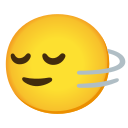
The shaking head emoji 🙂↔️ means "no," disbelief, or resigned disapproval — a face turning side to side like someone shaking their head. In texts it usually reads as fond exasperation ("I can't with you") rather than genuine anger or a hard refusal.
Head Shaking Horizontally
Shaking Head Emoji 🙂↔️
The animated "no" face — what 🙂↔️ actually signals in texts, and why it lands softer than 🙄.
Officially named Head Shaking Horizontally, 🙂↔️ arrived in Unicode 15.1 (2023) as a smiling face joined to a left-right arrow. Because the base face is a plain 🙂 rather than a frown, it carries a light, almost amused tone — the emoji equivalent of shaking your head while trying not to laugh. Its vertical twin 🙂↕️ means the opposite: yes.
✍️ Written & reviewed against real usage · verified Unicode 16.0
Tap to copy · pastes in WhatsApp, Instagram, anywhere
Shaking Head emojis to copy & paste
These are the real emoji characters — tap one to copy it, then paste anywhere. Because they’re text, they show up as emoji wherever you send them.
Shaking Head & related emojis
Shaking Head combos
What the shaking head emoji means
In practice 🙂↔️ does three jobs. First, a literal "no" — answering a yes/no question without typing a word, which is why it spread fast in group chats and Discord polls. Second, disbelief at something dumb or outrageous: someone sends a screenshot of their ex's text, you send 🙂↔️ back. Third, self-directed defeat — "booked the flight for the wrong month 🙂↔️" — where you're shaking your head at yourself. The tone is almost always gentle. Unlike 🙄, which accuses, or 😑, which shuts down, 🙂↔️ keeps the smile intact, so it signals "this is ridiculous and I'm still here." Gen Z leans on it for deadpan comedy captions; older users who do send it tend to mean the straightforward "nope."
💬
iMessage & texts
Used as a one-tap answer to a yes/no question, or as a reaction to something absurd a friend just admitted. Reads warmer than a plain 'no'.
🎵
TikTok comments
Deadpan punctuation under fail videos and bad-take stitches. Often the entire comment, letting the video carry the joke.
👻
Snapchat
Sent over a photo as silent commentary — usually mock disapproval at an outfit, a plate of food, or someone's 3am location.
💘
Dating apps
A soft decline that keeps the chat alive. Answering a pushy 'send pic?' with 🙂↔️ says no without escalating into a confrontation.
💼
Work chat
Risky. In Slack it can read as passive-aggressive disagreement with a colleague's idea. Safer on your own mistakes than on someone else's.
See it in real chats
How it actually lands in a chat
ok don't be mad but I texted him back
🙂↔️
I KNOW. I know.
not mad. just shaking my head in 4k
deserved 😭
Q. What does 🙂↔️ mean from a girl or guy?
When a girl sends 🙂↔️ she's usually saying "you're impossible" with affection attached — the smile is doing real work. It shows up when you say something corny, when you're wrong but confident, or when she's turning down a plan without wanting to sound cold ("2am? 🙂↔️"). It's a soft no, not a slammed door, and it invites you to keep talking. Read it as flirty deflection when the thread is already playful. Read it as a genuine boundary when it arrives alone, with no follow-up message — that silence after is the actual signal, not the emoji.
🙂↔️ vs 🙂↕️ — no vs yes
Head Shaking Horizontally 🙂↔️ and Head Shaking Vertically 🙂↕️ look closely related and get swapped constantly, but they land differently in a message. Here is what separates them, so you send the one you actually mean.
🙂↔️
Head Shaking Horizontally
Side-to-side motion. Means no, disbelief, or 'I can't with you.' The default of the pair — far more used, because disagreeing is funnier than agreeing.
vs
🙂↕️
Head Shaking Vertically
Up-and-down motion. Means yes, agreement, or emphatic 'exactly.' Often used to co-sign someone else's take without typing. Easy to mix up at small sizes — check the arrow direction.
How 🙂↔️ looks on every platform
It’s the same character everywhere — each platform just draws it in its own style. Here are three open emoji sets side by side, plus how your own device renders it:
🙂↔️
Your device
Twitter / X
Google (Noto)
OpenMoji
Platform
How it differs
Apple
Added in iOS 17.4. Yellow 🙂 face duplicated with motion lines on both sides — clearly a shake, not a blur.
Google
Noto Color Emoji shows a single face with curved motion arcs left and right. Requires Android 14 QPR3 or newer to render.
Samsung
Supported from One UI 6.1. Slightly rounder face with wider swing lines; reads more cartoonish than Apple's.
Microsoft
Windows shipped this late — older Segoe UI Emoji installs break the ZWJ sequence into 🙂 followed by ↔️, which loses the meaning entirely.
WhatsApp
Supported since the 2024 emoji update. Renders in-app even where the system font lacks it, so it works on older Androids.
Twitter
X/Twemoji has been slow on Emoji 15.1 ZWJ sequences; on web it can still fall back to two separate glyphs.
Apple, Samsung and WhatsApp draw their own proprietary versions, which we don’t redistribute — the notes above describe how they differ. Open sets shown under their licences: Twemoji (CC-BY 4.0), Noto Emoji (Apache 2.0), OpenMoji (CC BY-SA 4.0).
Where 🙂↔️ goes wrong
The shaking head emoji 🙂↔️ is not always read the way you intend it. These three situations change what 🙂↔️ signals, and knowing them keeps you from sending the wrong message.
It is new (2023), so a meaningful share of devices still split it into 🙂 + ↔️ — two unrelated symbols that make your message look like a typo. If the recipient is on an old phone or Windows desktop, type the word instead.
It is not an anger emoji. Sending it to someone who is genuinely upset reads as smug or dismissive, because the face is still smiling while you disagree.
In work chat it can land as passive-aggressive. 'Shipping Friday 🙂↔️' tells your manager you object but won't say so — use words.
There is no hidden sexual or drug meaning, despite what listicles claim. It is exactly what it looks like: someone shaking their head no.
Do not confuse it with 🙂↕️. The vertical arrow version means yes, and sending the wrong one flips your entire message.
Frequently asked
Quick answers to what people ask most about the shaking head emoji 🙂↔️ — what it means in a text, who tends to send it, and how to copy it onto your own keyboard.
What does 🙂↔️ mean?
🙂↔️ means no, disbelief, or mild disapproval. Its official Unicode name is Head Shaking Horizontally, and it depicts a face turning side to side. In messages it usually means 'I can't believe this' or 'nope,' delivered with a light, non-hostile tone.
What does the shaking head emoji mean from a girl?
From a girl 🙂↔️ is usually affectionate exasperation — 'you're impossible' — rather than real annoyance. It also works as a soft refusal that avoids sounding harsh. Whether it's flirty or a boundary depends on whether she keeps the conversation going afterward.
Is 🙂↔️ the same as the rolling eyes emoji?
No. 🙄 accuses the other person and reads as contempt or annoyance. 🙂↔️ keeps a neutral smile, so it lands as amused disbelief or a gentle no. Rolling eyes escalates a conversation; the shaking head usually defuses it.
Why does 🙂↔️ show as two emojis on my phone?
It is a ZWJ sequence — a smiling face joined to a left-right arrow by an invisible character. Devices without Emoji 15.1 support cannot merge them, so they display 🙂 and ↔️ separately. Updating iOS, Android, or Windows fixes it.
What is the opposite of the shaking head emoji?
🙂↕️, Head Shaking Vertically, is the direct opposite. It shows the same face nodding up and down and means yes or agreement. Both were added together in Emoji 15.1 and are designed as a matching yes/no pair.
When was the shaking head emoji added?
It was approved in Unicode 15.1 and Emoji 15.1 in September 2023. Apple shipped it in iOS 17.4 in March 2024, with Google, Samsung, and WhatsApp following through 2024. That recency is why support is still uneven.
Is it rude to send 🙂↔️?
Usually not among friends, where it reads as playful disbelief. It becomes rude in professional chats or during a serious disagreement, because smiling while refusing can look dismissive. Reserve it for casual threads and for laughing at your own mistakes.
Related emoji guides
If 🙂↔️ came up in a conversation, these are the emoji people most often look up next — each one explained the same way, with meanings you can actually use and characters you can copy.