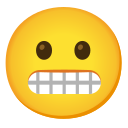
😬 is the cringe emoji. It means awkward, yikes, I feel secondhand embarrassment — a clenched-teeth grimace people send when something is uncomfortable, badly timed or slightly their fault.
U+1F62C
Cringe Emoji 😬
Grimacing face — the internet's default "yikes, that's awkward" reaction
The cringe emoji is 😬 grimacing face. It signals awkwardness, secondhand embarrassment or nervous tension — the visual version of saying "yikes" or "oof" after something uncomfortable, cringey or mildly self-inflicted happens.
✍️ Written & reviewed against real usage · verified Unicode 16.0
Tap to copy · pastes in WhatsApp, Instagram, anywhere
Cringe emojis to copy & paste
These are the real emoji characters — tap one to copy it, then paste anywhere. Because they’re text, they show up as emoji wherever you send them.
Cringe & related emojis
Cringe combos
What the cringe emoji means
There is no emoji literally named "cringe" in Unicode, so the internet elected 😬 grimacing face as the stand-in. The design is all teeth: a wide clenched grin with eyes that are not smiling. That mismatch is the whole point — the mouth says "haha" while the eyes say "please make this stop." People reach for it in three situations. First, secondhand embarrassment: someone posts a bad take, gets left on read in public, or a friend texts their ex again. Second, self-inflicted awkwardness: you sent a message to the wrong chat, forgot a birthday, or double-booked plans — 😬 is the apology-adjacent softener before you explain. Third, bracing tension: "so I told your mum about the tattoo 😬" — it flags that bad news is coming and asks the reader not to be too mad. It is also the polite way to deliver a no. "Can you cover my shift Saturday? 😬" reads as reluctance without a flat refusal. Tone-wise 😬 is softer than laughing at someone: it says "this is uncomfortable and I am uncomfortable with you," which is why it lands as sympathetic rather than mean.
💬
In texts
Softens bad news or a reluctant no — "I can't make it 😬" reads apologetic, not cold.
📱
In DMs
Reaction to a screenshot of someone else's mess: secondhand embarrassment, no words needed.
🎵
On TikTok
Caption fuel for fail clips, awkward-encounter storytimes and "why did I say that" POVs.
💼
At work
Slack's polite panic button — flagging a missed deadline or an awkward client email.
Q. What does 😬 mean from a girl or guy?
When a girl sends 😬 she is usually flagging awkwardness, not anger. Most often it means "this is uncomfortable and I'd rather not make it worse" — a soft no, a nervous confession ("I might have told her 😬"), or sympathy for something embarrassing you shared. If it follows her own message, she is bracing for your reaction and hoping you take it lightly. If it follows yours, read it as a gentle oof, that was a bit much — she is signalling you crossed a small line without wanting a fight. It is very rarely flirty and almost never sarcastic; a girl teasing you would reach for 😏 or 😂 instead. A lone 😬 with no text usually means the conversation just hit a topic she wants to move past.
😬 vs 😅 — awkward or relieved?
Grimacing Face 😬 and Grinning Face with Sweat 😅 look closely related and get swapped constantly, but they land differently in a message. Here is what separates them, so you send the one you actually mean.
😬
Grimacing Face
Tension that has not been released. The awkward moment is still happening and the sender is bracing for your reaction.
vs
😅
Grinning Face with Sweat
Tension already released. A nervous laugh after dodging something — "phew, that was close" rather than "oh no, this is bad."
How 😬 looks on every platform
It’s the same character everywhere — each platform just draws it in its own style. Here are three open emoji sets side by side, plus how your own device renders it:
😬
Your device
Twitter / X
Google (Noto)
OpenMoji
Platform
How it differs
Apple / iOS
Bright yellow face with a very wide clenched-teeth grin and flat, unamused eyes — the most classic cringe read.
Google / Android
Rounder face, teeth drawn as a single wide band; slightly friendlier and closer to a nervous smile.
Samsung
Softer gradient face with visible tooth separation, reads more "awkward laugh" than pained grimace.
WhatsApp
Simplified flat design with narrow eyes; often mistaken for a plain toothy smile on small screens.
X / Twemoji
Minimal flat style, teeth as a clean white rectangle — the tension reads mainly from the straight eyes.
Apple, Samsung and WhatsApp draw their own proprietary versions, which we don’t redistribute — the notes above describe how they differ. Open sets shown under their licences: Twemoji (CC-BY 4.0), Noto Emoji (Apache 2.0), OpenMoji (CC BY-SA 4.0).
Where 😬 gets misread
The cringe emoji 😬 is not always read the way you intend it. These three situations change what 😬 signals, and knowing them keeps you from sending the wrong message.
On some platforms the grimace looks like a wide happy grin, so a nervous "yikes" can land as an enthusiastic smile — risky in work chats.
Older users and some non-English speakers read 😬 as excitement or a big smile rather than cringe, because the teeth register before the eyes.
It is not a substitute for an apology. Ending a genuinely bad message with 😬 can read as minimising rather than owning it.
Frequently asked
Quick answers to what people ask most about the cringe emoji 😬 — what it means in a text, who tends to send it, and how to copy it onto your own keyboard.
What is the cringe emoji?
There is no emoji officially named cringe in Unicode. People use 😬 grimacing face (U+1F62C) as the cringe emoji because its clenched teeth and tense eyes read as awkwardness and secondhand embarrassment.
What does 😬 mean in a text?
It means yikes, awkward or oops. Senders use it to soften bad news, admit a small mistake, decline something reluctantly, or react to something embarrassing you told them.
Is 😬 rude or passive aggressive?
Usually not. It is more sympathetic than mocking, because it shows the sender is uncomfortable too. It can read passive aggressive only when it replaces a real answer, like a bare 😬 after a request.
What is the difference between 😬 and 😅?
😅 is relief after a close call or a nervous laugh that has already resolved. 😬 is unresolved tension: the awkward thing is still hanging in the air and nobody has laughed it off yet.
What does 😬 mean from a girl?
Most often awkwardness or a soft no rather than flirting or anger. It signals she finds the moment uncomfortable and wants to move on without escalating.
What emoji means secondhand embarrassment?
😬 is the main one. 🫣 face with peeking eye and 🙈 see-no-evil monkey are close alternatives for when something is too cringe to watch directly.
Related emoji guides
If 😬 came up in a conversation, these are the emoji people most often look up next — each one explained the same way, with meanings you can actually use and characters you can copy.