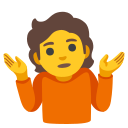
🤷 means "I don't know" or "I don't care, it is what it is" — a shrug of uncertainty, resignation, or polite deflection.
U+1F937
Shrug Emoji 🤷
Meaning, copy and paste, related gesture emojis and combos.
🤷 means "I don't know" or "I don't care — it is what it is." People send it to admit they have no answer, to accept something they can't change, or to deflect blame. Alone it can read passive-aggressive; with 😅 or 😂 it reads friendly.
✍️ Written & reviewed against real usage · verified Unicode 16.0
Tap to copy · pastes in WhatsApp, Instagram, anywhere
Shrug emojis to copy & paste
These are the real emoji characters — tap one to copy it, then paste anywhere. Because they’re text, they show up as emoji wherever you send them.
Shrug & related emojis
Shrug combos
What the shrug emoji means
🤷 is the shrug: palms turned up, shoulders lifted, eyebrows raised. In texting it covers three overlapping meanings — genuine ignorance ("no idea 🤷"), resigned acceptance ("it is what it is 🤷"), and blame-shifting ("I warned them 🤷"). The third is where it gets sharp: sent with no accompanying text, 🤷 is one of the most reliably passive-aggressive emoji in English chat, closer to "believe whatever you want" than to a real answer. On TikTok and in captions it works as a punchline shrug — you state something slightly indefensible, then close with 🤷 to signal you're not going to justify it. It also stands in for the older kaomoji ¯\\_(ツ)_/¯, which carries the same idea in a more ironic, chronically-online tone.
🤷
I genuinely don't know
The literal use: you were asked a question and you have no answer. "Why did they cancel? 🤷" Reads as neutral and honest, not rude.
🤷♀️
Not my problem
Deflecting responsibility with a bit of attitude. "I told them twice 🤷♀️" — you tried, you're done, the consequences are theirs now.
🤷
It is what it is
Acceptance of something you can't change: flight delayed, price went up, plans fell apart. Softer and more resigned than annoyed.
🤷
Passive-aggressive full stop
Sent alone after a disagreement, 🤷 can mean "believe what you want." It ends the conversation without conceding anything — the riskiest use.
See it in real chats
Group chat, 11:40pm
wait is the thing tomorrow at 6 or 7
🤷 nobody has told me anything
so we just show up at 6 and vibe
guess so 🤷😅 worst case we get food first
Q. What does 🤷 mean from a girl or guy?
When a girl sends 🤷, the safest read is the plain one: she doesn't know, or she's accepted something she can't change. It is not a flirting emoji and it carries no romantic subtext. The nuance is in what surrounds it. Attached to real words ("no clue what time it starts 🤷") it's just casual honesty. Sent alone, as the entire reply to a question you asked about the two of you, it usually means she's done explaining and is signalling mild irritation or emotional distance without starting an argument. The same logic applies when a guy sends it. In both cases, 🤷 plus 😂 or 😅 is warm; 🤷 as a one-character message after a disagreement is a soft shutdown, and asking a gentle follow-up question works far better than replying with a shrug of your own.
🤷 vs 💁 — shrug or sass?
Person shrugging 🤷 and Person tipping hand 💁 look closely related and get swapped constantly, but they land differently in a message. Here is what separates them, so you send the one you actually mean.
🤷
Person shrugging
Both palms up, shoulders raised, eyebrows lifted. Means "I don't know" or "it is what it is." The symmetrical two-handed pose is the giveaway.
vs
💁
Person tipping hand
One hand up, palm angled, widely read as sass or "obviously" (originally the information-desk gesture). Often mistaken for a shrug, but it signals confidence, not confusion.
How 🤷 looks on every platform
It’s the same character everywhere — each platform just draws it in its own style. Here are three open emoji sets side by side, plus how your own device renders it:
🤷
Your device
Twitter / X
Google (Noto)
OpenMoji
Platform
How it differs
Apple
3D-shaded figure with both palms open, flat mouth and one eyebrow raised — reads distinctly unimpressed rather than merely unsure. The keyboard usually offers 🤷♀️ or 🤷♂️ first, not the neutral 🤷.
Google
Flat Noto design, blue-grey figure with palms up and a small neutral mouth. Softer and more genuinely puzzled than Apple's; the gender-neutral 🤷 shows short hair and a plain top.
Samsung
One UI draws a rounder, more cartoon figure with visibly raised shoulders and wide eyes, which reads friendlier and more comic than other vendors — less attitude, more confusion.
Microsoft
The Fluent design shows a full upper body with strongly angled shoulders, so the shrug motion is the clearest of any vendor. In Teams and Outlook the animated Fluent version actually lifts the shoulders.
WhatsApp
Uses its own emoji set: a simple palms-up figure with a neutral mouth. It renders identically inside WhatsApp on Android and iOS, so both sides of a chat see the same shrug regardless of phone.
Apple, Samsung and WhatsApp draw their own proprietary versions, which we don’t redistribute — the notes above describe how they differ. Open sets shown under their licences: Twemoji (CC-BY 4.0), Noto Emoji (Apache 2.0), OpenMoji (CC BY-SA 4.0).
When 🤷 does not mean "I don't know"
The shrug emoji 🤷 is not always read the way you intend it. These three situations change what 🤷 signals, and knowing them keeps you from sending the wrong message.
Alone, it stings. A solo 🤷 with no text, replying to something someone cares about, reads as dismissal rather than uncertainty. Pair it with words or a softening emoji if you don't mean to shut the conversation down.
Not the same as ¯\_(ツ)_/¯. The text kaomoji is not a Unicode emoji and does not paste reliably — many apps eat the backslash. If you need something that renders everywhere, use 🤷.
Wrong register at work. In an email or a ticket, 🤷 reads as "I'm not looking into this." Say "I don't have that information yet" instead; save the shrug for chat with people who know your tone.
Frequently asked
Quick answers to what people ask most about the shrug emoji 🤷 — what it means in a text, who tends to send it, and how to copy it onto your own keyboard.
What does the 🤷 emoji mean?
It means "I don't know," "I don't care," or "it is what it is." The emoji shows a person with palms up and eyebrows raised, the universal shrug. Tone depends entirely on context: alone it can read cold, but paired with 😅 or 😂 it reads friendly and casual.
Is 🤷 rude or passive-aggressive?
It can be. A single 🤷 with no words, sent after someone raises a problem, often lands as dismissive — "not my problem, think what you like." Used inside a sentence or with a laughing or smiling emoji, it reads as harmless honesty. If you're in a tense conversation, add words.
What is the difference between 🤷, 🤷♀️ and 🤷♂️?
They are the same base emoji. 🤷 (U+1F937) is gender-neutral; 🤷♀️ and 🤷♂️ are ZWJ sequences that add the woman and man signs. Most keyboards default to 🤷♀️ or 🤷♂️ depending on your last pick, which is why the neutral version is rarer in real chats.
Is ¯\_(ツ)_/¯ the same as the shrug emoji?
No. ¯\_(ツ)_/¯ is a Japanese-style kaomoji built from ordinary text characters, not a Unicode emoji. It predates 🤷 by years and carries a more ironic, internet-native tone. 🤷 is the actual emoji and is what emoji keyboards and search results mean by "shrug emoji."
What does 🤷 mean from a girl?
Usually the same as from anyone: no idea, or mild resignation. Read the rest of the message. "idk what he wants 🤷" is genuine confusion; a solo 🤷 answering a direct question about you is often a soft signal she's annoyed or has disengaged and doesn't want to spell it out.
When was the shrug emoji added?
🤷 was approved in Unicode 9.0 and Emoji 3.0 in 2016, alongside 🤦 face palm. The gendered ZWJ variants 🤷♀️ and 🤷♂️ arrived with Emoji 4.0 the same year, and skin tone modifiers apply to all three.
Related emoji guides
If 🤷 came up in a conversation, these are the emoji people most often look up next — each one explained the same way, with meanings you can actually use and characters you can copy.