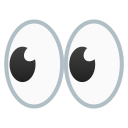
👀 means side eye — suspicion, judgment or "I'm watching this go down."
U+1F440
Side eye Emoji 👀
Meaning, copy and paste, related eye emojis and side-eye combos.
The 👀 eyes emoji is the internet's side eye — people send it to signal suspicion, quiet judgment, awkward interest or "I saw that." It flags drama, shade, secondhand embarrassment and "ooh, tell me more" all at once.
✍️ Written & reviewed against real usage · verified Unicode 16.0
Tap to copy · pastes in WhatsApp, Instagram, anywhere
Side eye emojis to copy & paste
These are the real emoji characters — tap one to copy it, then paste anywhere. Because they’re text, they show up as emoji wherever you send them.
Side eye & related emojis
Side eye combos
What the side eye emoji means
Although Unicode never made an emoji literally named "side eye," 👀 is the character everyone actually uses for it. On TikTok, X and in texts it reads as skeptical, nosy or lowkey judging — a glance that says "I'm watching," "this is sus," or "spill the tea." It's the go-to reaction to drama, a bold statement, a thirst trap, or an awkward moment you're side-eyeing from a distance. Dry and ambiguous, it can be flirty, shady or pure comedy depending on the chat. Some people also use 🙄, 😒 or 🫣 to hit the same side-eye energy.
🤨
Suspicion
"This is sus" — you don't fully believe what you just heard.
🍵
Tell me more
Nosy interest in drama or gossip: spill it.
😒
Quiet judgment
Silent shade at something cringe or bold.
😏
Flirty glance
A playful side-eye that says "I noticed you."
Q. What does 👀 mean from a girl or guy?
When a girl sends 👀 it's usually playful, not hostile. It can mean she's intrigued and lowkey watching you ("ooh, I saw that"), she's teasing you, or she wants you to explain something juicy. Paired with 😏 or 👉👈 it leans flirty and curious; paired with 😒, 🙄 or 🚩 it flips to judgy or unimpressed. Context and the rest of the thread decide whether it's a wink or a warning, so read the tone before assuming she's mad.
👀 vs 🙄 — which is the real side eye?
Eyes 👀 and Rolling eyes 🙄 look closely related and get swapped constantly, but they land differently in a message. Here is what separates them, so you send the one you actually mean.
👀
Eyes
A sideways glance: suspicion, curiosity or "I'm watching this." Ambiguous and can be flirty, nosy or shady.
vs
🙄
Rolling eyes
Eyes rolled upward showing annoyance, sarcasm or "whatever." Clearly irritated, less curious than 👀.
How 👀 looks on every platform
It’s the same character everywhere — each platform just draws it in its own style. Here are three open emoji sets side by side, plus how your own device renders it:
👀
Your device
Twitter / X
Google (Noto)
OpenMoji
Platform
How it differs
Apple
Two glossy blue-ringed eyes glancing to the side and slightly up — the classic side-eye look.
Google
Simpler cartoon eyes looking left, less shading than Apple's.
Samsung
Rounder eyes with a lighter tone, gaze angled to the side.
Microsoft
Flatter, wide-set eyes looking sideways with minimal gloss.
WhatsApp
Bright, cartoonish eyes tracking to the side, close to Apple's vibe.
Apple, Samsung and WhatsApp draw their own proprietary versions, which we don’t redistribute — the notes above describe how they differ. Open sets shown under their licences: Twemoji (CC-BY 4.0), Noto Emoji (Apache 2.0), OpenMoji (CC BY-SA 4.0).
When 👀 does not mean side eye
The side eye emoji 👀 is not always read the way you intend it. These three situations change what 👀 signals, and knowing them keeps you from sending the wrong message.
Literal watching. Sometimes it just means "I've seen your message" or "eyes on this," like a read receipt or a heads-up.
Hype, not shade. With 🔥 or 🍿 it can signal excitement — "I'm here for this" — rather than judgment.
Not always eyes. Some people mean the same side-eye energy with 🙄, 😒 or 🫣, so the exact character varies by person.
Frequently asked
Quick answers to what people ask most about the side eye emoji 👀 — what it means in a text, who tends to send it, and how to copy it onto your own keyboard.
What does the side eye emoji 👀 mean?
It signals side eye — suspicion, quiet judgment, nosiness or "I'm watching this." It's used to react to drama, something sus, a bold move or an awkward moment.
Is there an official side eye emoji?
No. Unicode never released an emoji named "side eye," so people use 👀 (Eyes) as the stand-in. Some also use 🙄, 😒 or 🫣 for similar energy.
What does 👀 mean from a girl?
Usually she's intrigued, teasing or lowkey watching you. With 😏 or 👉👈 it's flirty and curious; with 😒 or 🚩 it turns judgy or unimpressed. Tone depends on the rest of the chat.
What does 👀 mean on TikTok?
It flags something juicy, shocking or sus — "look at this," "tell me more," or "the drama." Often paired with 🍵 for gossip or 🔥 for hype.
Is the side eye emoji rude?
It can be shady or judgmental, but it's just as often playful or curious. It's ambiguous by design, so context decides whether it's teasing or throwing shade.
What's the difference between 👀 and 🙄?
👀 is a sideways glance meaning suspicion, interest or "I'm watching." 🙄 rolls the eyes upward to show annoyance, exasperation or "whatever." Both get called side eye, but 🙄 is more clearly irritated.
Related emoji guides
If 👀 came up in a conversation, these are the emoji people most often look up next — each one explained the same way, with meanings you can actually use and characters you can copy.