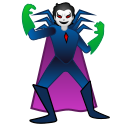
🦹 is the supervillain emoji, officially named "supervillain" in Unicode, and it shows a caped, masked figure. People use it as the robber or bad-guy emoji to mark scheming, mischief, petty revenge, or a joking admission that they are the villain in a story.
Supervillain
Robber Emoji 🦹
The supervillain emoji — cape, mask, and a whole lot of "yes, I did that on purpose."
Tap or click the 🦹 above to copy it, then paste anywhere — texts, captions, bios, usernames, Discord, Notion, spreadsheets. It pastes as a single character and carries its meaning with it, which is why it works best as the last emoji in a sentence. Officially Unicode calls it "supervillain" (U+1F9B9), approved in Emoji 11.0 in 2018 alongside 🦸 superhero. Search traffic finds it under "robber emoji," "villain emoji," "bad guy emoji," and "criminal emoji" — none of which are its real name, all of which describe how it actually gets used. It also has explicit gendered forms: 🦹♀️ woman supervillain and 🦹♂️ man supervillain, each built from the base glyph plus a gender sign. If you want the neutral one, 🦹 alone is it, and it renders as its own distinct design on Apple and Google rather than defaulting to a man.
✍️ Written & reviewed against real usage · verified Unicode 16.0
Tap to copy · pastes in WhatsApp, Instagram, anywhere
Robber emojis to copy & paste
These are the real emoji characters — tap one to copy it, then paste anywhere. Because they’re text, they show up as emoji wherever you send them.
Robber & related emojis
Robber combos
What the robber emoji means
In practice 🦹 almost never means literal crime. It means intent. Someone sends it when they've done something slightly diabolical and want credit for it — texted the ex, scheduled the meeting at 8am on purpose, ate the last slice and said nothing. It's the emoji equivalent of steepling your fingers. Gen Z uses it flatly and constantly: "just booked the aisle AND the window seat 🦹" — no villain arc implied, just a small win taken unfairly. Millennials tend to use it more narratively, as a costume, tied to the superhero-movie frame it came from. There's a heavier register too. People use 🦹 to reclaim an accusation: when someone's been cast as the bad guy in a friend group or a breakup, dropping 🦹 in a caption says "fine, I'll play the part" — defensive, funny, and a little raw at once. That's the tone shift to watch for. The same glyph reads as harmless mischief from a friend and as a shot across the bow from someone you're in conflict with, and context is the only thing separating them.
🎬
TikTok villain era
Pinned to "villain era" and glow-up edits — captions like "stopped explaining myself 🦹" where the emoji marks the turn from doormat to done.
👻
Snapchat confessions
Sent on a snap right after doing something petty. Low stakes, fast, and it softens the confession into a joke before anyone can react badly.
💬
Group chat scheming
The emoji that closes a plan message. "Ok so we tell her we're going to dinner and THEN 🦹" — signals deliberate mischief, not an actual secret.
💘
Dating app bios
Shorthand for playful trouble: "probably your mother's least favorite 🦹". Reads as self-aware humor rather than a real red flag.
🎮
Gaming and Discord
Marks the player who camps, trolls, or picks the annoying strategy. On Discord it's near-literal — a role tag for whoever runs the chaos.
See it in real chats
How it lands in a real thread
wait did you seriously book the 6am flight for both of us
cheaper by $140 🦹
you're evil
i'm efficient. same thing 🦹🧠
Q. What does 🦹 mean from a girl or guy?
If a girl sends you 🦹, read it as confidence, not flirting. It's a self-cast: she's telling you she did the slightly ruthless thing and isn't apologizing. "Left him on read 🦹" or "told your mom you liked the sweater 🦹" mean the same thing — she's owning the move and expecting you to find it funny rather than judge it. It's a warm, in-on-the-joke emoji, usually a sign she's comfortable enough to show you the calculating side. Where it turns cold is mid-argument: 🦹 there is sarcasm, and it means she's heard the accusation and is refusing to argue with it.
🦹 vs 🥷 — the mix-up everyone arrives with
Supervillain 🦹 and Ninja 🥷 look closely related and get swapped constantly, but they land differently in a message. Here is what separates them, so you send the one you actually mean.
🦹
Supervillain
Caped, masked, theatrical. Means deliberate scheming and owning the bad-guy role out loud. Loud, comic-book, self-aware. Unicode 11.0, 2018, so it renders almost everywhere.
vs
🥷
Ninja
Black hood, no cape, crouched. Means stealth — sneaking out, lurking, doing it unnoticed. Quiet where 🦹 is showy. Unicode 13.0, 2020, so it's missing on older phones.
How 🦹 looks on every platform
It’s the same character everywhere — each platform just draws it in its own style. Here are three open emoji sets side by side, plus how your own device renders it:
🦹
Your device
Twitter / X
Google (Noto)
OpenMoji
Platform
How it differs
Apple
Purple caped figure with a black domino mask and a green face, shown side-on with the cape flaring. The most comic-book of the set and the most instantly readable.
Google
Front-facing purple-and-black outfit with a wide mask. Flatter and rounder than Apple's, so it reads more cartoon than menacing at small sizes.
Samsung
Slimmer figure with a pointed cape and a lighter palette. On older One UI builds it can look almost heroic, which blunts the joke entirely.
WhatsApp
Follows Google's design on Android and Apple's on iPhone, so the same message can look noticeably different to different people in one chat.
Discord / Windows
Discord uses Twemoji: a flat purple villain with a simple mask. Windows 11's Fluent version is small and easy to mistake for 🦸 superhero.
Older devices
Anything predating 2018 shows a tofu box □, since Emoji 11.0 came after their font. Rare now, but still happens on legacy Androids, smart TVs, and some POS systems.
Apple, Samsung and WhatsApp draw their own proprietary versions, which we don’t redistribute — the notes above describe how they differ. Open sets shown under their licences: Twemoji (CC-BY 4.0), Noto Emoji (Apache 2.0), OpenMoji (CC BY-SA 4.0).
Where 🦹 gets misread
The robber emoji 🦹 is not always read the way you intend it. These three situations change what 🦹 signals, and knowing them keeps you from sending the wrong message.
It is not a robber emoji and never was. Unicode has no burglar, thief, or bank-robber character, so if you need literal crime you have to pair 🦹 with 💰 or 🚔 and hope the reader connects them — on its own it reads as costume, not crime.
At small sizes 🦹 and 🦸 superhero are genuinely hard to tell apart, especially in a Windows or Samsung notification preview. If the whole point of your message is the villain twist, spell it out in words too.
Mid-argument it reads as contempt. "Ok 🦹" in a real fight is heard as "I'm not apologizing and I find this funny," which escalates faster than almost any other emoji. Save it for after the conflict, not during.
It ages you in one direction and dates you in the other. Millennials read it as a Marvel reference; Gen Z reads it as flat, ironic self-deprecation. Used earnestly by anyone over 35 in a work Slack it lands as try-hard, not playful.
The myth that 🦹 is a coded drug, theft, or gang signal is false. It has no covert meaning, no platform flags it, and no moderation system treats it as a warning sign — it's a 2018 superhero-movie emoji doing exactly what it looks like.
Frequently asked
Quick answers to what people ask most about the robber emoji 🦹 — what it means in a text, who tends to send it, and how to copy it onto your own keyboard.
Is there an actual robber emoji?
No. Unicode has never approved a robber, thief, or burglar emoji. 🦹 supervillain is the closest match and is what most people use, with 🥷 ninja as the runner-up when the vibe is sneaky rather than theatrical.
What does 🦹 mean when a friend sends it?
That they did something mildly diabolical and want you to know it was on purpose. It's a brag disguised as a confession — petty revenge, a strategic move, or breaking a small rule with zero remorse.
Is 🦹 the same as 😈?
No. 😈 is mischievous and often flirty or sexual in DMs. 🦹 is about agency and scheming with no romantic layer at all. Sending 🦹 where you meant 😈 will land completely differently.
Does 🦹 have male and female versions?
Yes. 🦹♀️ is woman supervillain and 🦹♂️ is man supervillain, each built from the base character plus a gender sign and a zero-width joiner. Plain 🦹 is gender-neutral with its own distinct artwork.
Why does 🦹 look different on my friend's phone?
Every platform draws its own version. Apple's is a green-faced figure in profile, Google's faces forward, Samsung's is slimmer and lighter. The underlying character is identical; only the font artwork changes.
Can I use 🦹 in a username or bio?
Yes on Instagram, TikTok, Discord, and X. Some form fields and older business tools strip four-byte characters, so it may silently vanish from LinkedIn headlines, certain email subject lines, and legacy CRM fields.
Is sending 🦹 ever taken seriously?
Almost never as a threat, but it can read as a refusal to apologize. In a live argument it says "I heard you and I'm not engaging," which lands as contempt even when you meant it lightly.
Related emoji guides
If 🦹 came up in a conversation, these are the emoji people most often look up next — each one explained the same way, with meanings you can actually use and characters you can copy.