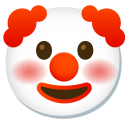
The clown emoji 🤡 usually means "I made a fool of myself" or "you are being fake". Most of the time it is aimed inward — self-roasting after getting played, ignored or over-hyping something that flopped.
U+1F921
Clown Emoji 🤡
Self-roast, fake behaviour and the "I got played" reaction — decoded
🤡 is the clown face emoji, added in 2016. Online it rarely means circus clown. It means foolishness: calling yourself a clown for being naive, calling someone else fake or performative, or reacting to something embarrassingly dumb.
✍️ Written & reviewed against real usage · verified Unicode 16.0
Tap to copy · pastes in WhatsApp, Instagram, anywhere
Clown emojis to copy & paste
These are the real emoji characters — tap one to copy it, then paste anywhere. Because they’re text, they show up as emoji wherever you send them.
Clown & related emojis
Clown combos
What the clown emoji means
Unicode calls 🤡 a clown face: white face paint, red nose, wild hair, painted smile. In actual usage the meaning flipped almost entirely to self-directed embarrassment. If someone waits three hours for a reply and finally texts "🤡", they are saying I am the fool here. Pointed at someone else it means fake, phony or all show — a person putting on a performance rather than being real. It also does duty as clown behaviour commentary: dumb takes, obvious lies, bad decisions you can see coming. Because clowns are also genuinely creepy to a lot of people, a small share of uses are about horror-movie clowns and coulrophobia, but that is the minority reading. Tone matters: one 🤡 alone lands harsh, while 🤡🤡🤡 in a group chat is usually joking. It is almost never affectionate, so avoid sending it to someone who is upset — it reads as mocking even when you meant it playfully.
📱
In texts
Self-roast after a bad call: "I actually believed him 🤡". Sent about you, it means you got fooled and you know it.
💬
In DMs
Aimed at someone, it calls them fake or performative. Sharp on its own — soften with a laugh or a second clown.
🎵
On TikTok
Clown-check content: "POV: you thought he was different 🤡". Also stamped on obviously wrong predictions and dumb takes.
🏟️
Sports and stan chat
Fans call themselves clowns after a loss, or label a rival's confident prediction clown behaviour before the game ends.
Q. What does 🤡 mean from a girl or guy?
From a girl, 🤡 is nearly always about herself, not you — a self-deprecating stamp meaning I got my hopes up and I feel stupid. If she sends it after a plan falls through or a slow reply, she is signalling disappointment while pretending to laugh it off, and the warm move is to acknowledge it instead of teasing. When she uses it about a third person, it means she thinks that person is fake or putting on an act. A single 🤡 sent straight at you mid-argument is not playful — it means she thinks you are being ridiculous or dishonest. Repeated clowns with other joke emoji are usually just banter.
How 🤡 looks on every platform
It’s the same character everywhere — each platform just draws it in its own style. Here are three open emoji sets side by side, plus how your own device renders it:
🤡
Your device
Twitter / X
Google (Noto)
OpenMoji
Platform
How it differs
Apple
Bright white face, red bulb nose, blue eyes and red-and-blue hair tufts with a wide painted smile.
Google
Rounder yellow-tinted face with red nose and blue hair; friendlier and less eerie than Apple's.
Samsung
Soft cartoon clown with pink cheeks and a smaller nose — reads more cute than mocking.
WhatsApp
Close to Apple's design with a flatter finish; renders the same across Android and iOS.
X and Discord
Twemoji clown: simple flat face, red nose, blue side hair. Discord shortcode is :clown:.
Apple, Samsung and WhatsApp draw their own proprietary versions, which we don’t redistribute — the notes above describe how they differ. Open sets shown under their licences: Twemoji (CC-BY 4.0), Noto Emoji (Apache 2.0), OpenMoji (CC BY-SA 4.0).
When 🤡 backfires
The clown emoji 🤡 is not always read the way you intend it. These three situations change what 🤡 signals, and knowing them keeps you from sending the wrong message.
Sent to someone who is genuinely upset, it reads as mockery no matter how you meant it.
A real fear of clowns is common, so 🤡 can land as creepy rather than funny with some people.
In work chats it looks like you are calling a colleague or their idea stupid — keep it out of professional threads.
Frequently asked
Quick answers to what people ask most about the clown emoji 🤡 — what it means in a text, who tends to send it, and how to copy it onto your own keyboard.
What does the clown emoji 🤡 mean from a guy?
Usually self-mockery — he is admitting he did something foolish or got played, and is laughing at himself before you can. Aimed at someone else, it means he thinks that person is fake or trying too hard.
Is the clown emoji an insult?
It can be. Calling someone a clown means you think they are foolish, fake or not to be taken seriously. Used about yourself it is harmless self-deprecation, which is how most people send it.
What does 🤡 mean on TikTok?
It marks clown behaviour — believing something obviously untrue, making a confident prediction that ages badly, or a POV video about getting your hopes up over someone who was never serious.
What is the difference between 🤡 and 🃏?
🤡 is a clown face used for foolishness and fakeness. 🃏 is a playing card joker, used for card games, Batman references and wildcard jokes rather than calling someone naive.
When was the clown emoji added?
Clown face was approved as part of Unicode 9.0 in 2016 and released with Emoji 3.0 that same year, so it works on all modern phones and platforms.
Can 🤡 mean actual clowns or the circus?
Yes, though it is the minority use. It shows up for birthday-party clowns, circus posts and horror-clown or coulrophobia jokes, usually alongside 🎪 or 🎈 to make the literal meaning clear.
Related emoji guides
If 🤡 came up in a conversation, these are the emoji people most often look up next — each one explained the same way, with meanings you can actually use and characters you can copy.