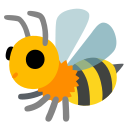
The bee emoji 🐝 mostly means "busy" — as in busy bee — or signals sweetness, hard work, and hive loyalty. Online it also tags Beyoncé's BeyHive fandom, save-the-bees environmental posts, and honey-themed nicknames like "honey bee."
Honeybee
Bee Emoji 🐝
One tap to copy, plus what 🐝 actually signals in texts, TikTok captions and DMs.
🐝 is a pun emoji before it is an animal emoji. Most sends are shorthand for busy, sweet, or hardworking — "swamped today 🐝" or "morning, honey bee 🐝" — and a smaller slice are fandom (BeyHive) or environmental (save the bees). Read the sentence around it: the literal insect meaning is the least common one.
✍️ Written & reviewed against real usage · verified Unicode 16.0
Tap to copy · pastes in WhatsApp, Instagram, anywhere
Bee emojis to copy & paste
These are the real emoji characters — tap one to copy it, then paste anywhere. Because they’re text, they show up as emoji wherever you send them.
Bee & related emojis
Bee combos
What the bee emoji means
In real messages 🐝 does four jobs. First, workload: "busy bee" compressed into one character, usually with a slightly cheerful spin — it softens "I can't talk" into something friendly rather than cold. Second, sweetness: paired with 🍯 it becomes a pet-name device, and on its own after a compliment it reads as warm and a little playful. Third, fandom: capital-B Beyoncé fans stack 🐝 in comments, and a bee under a Beyoncé post is a loyalty flag, not a compliment to the poster. Fourth, cause-posting — pollinators, gardening, beekeeping, "no bees no food" captions. There is also a small aesthetic use: yellow-and-black cottagecore/goblincore bios where 🐝 is decoration with no message at all. Tone stays gentle across all four; 🐝 is almost never aggressive or sexual, which makes it a safe emoji in ambiguous chats.
💬
Texting
Softens a decline. "Can't tonight, busy bee 🐝" lands warmer than a flat no — it signals the reason is workload, not you.
🎵
TikTok
Two lanes: BeyHive comment stacks under Beyoncé clips, and cottagecore/gardening captions where 🐝 sets a soft yellow palette. Sound choice tells you which.
📸
Instagram
Bio decoration and Story stickers. Paired with 🌻🍯 it's an aesthetic set; used alone in a caption it usually means hustle or a literal bee photo.
❤️🔥
Dating apps
Low-risk warmth. Nicknaming someone "bee" is playful without being forward, which is exactly why it stays common in early chat — and why it rarely escalates anything.
💼
Work chat
Safe in Slack. "Busy bee 🐝" reads as self-deprecating and human. Sending it *at* a colleague who's behind, though, reads as a nudge about their pace.
See it in real chats
How 🐝 actually lands in a real thread
you free later or still swamped
still swamped 🐝 three deadlines today
ok busy bee 🍯 tomorrow then?
tomorrow for sure. save me a coffee
🐝💛
Q. What does 🐝 mean from a girl or guy?
When a girl sends 🐝 it's usually warmth without weight. Attached to a compliment or a nickname ("hey honey bee 🐝") it's affectionate but low-stakes — friendlier than 😊, far less loaded than 😏 or 🥺. Attached to plans it means she's genuinely busy and is trying not to sound like she's brushing you off. In her bio or a story it's often just aesthetic: bees are a common cottagecore motif. It is not a coded flirt signal and it doesn't carry a hidden sexual meaning, so don't over-read a single bee. Escalation, if any, shows up in her words, not the insect.
🐝 vs 🍯 — sweet-but-busy vs pure sweetness
Bee 🐝 and Honey Pot 🍯 look closely related and get swapped constantly, but they land differently in a message. Here is what separates them, so you send the one you actually mean.
🐝
Bee
Carries a work note under the warmth. Signals someone is hustling, sweet, or repping the BeyHive. Playful, never forward.
vs
🍯
Honey Pot
Pure affection and pet-name territory, no workload subtext. Sent alone it reads flirtier than 🐝 and lands closer to "babe."
How 🐝 looks on every platform
It’s the same character everywhere — each platform just draws it in its own style. Here are three open emoji sets side by side, plus how your own device renders it:
🐝
Your device
Twitter / X
Google (Noto)
OpenMoji
Platform
How it differs
Apple
Side-on honeybee with translucent wings and a soft gradient body; small on screen, so the stripes can blur into a yellow smudge in dense text.
Google
Top-down cartoon bee, rounder and more insect-like than Apple's, with clearly separated wings — reads more literal, less cute.
Samsung
Cheerful bee with a visible face and big eyes, which pushes it further toward pet-name and kid-friendly territory than other platforms.
Microsoft
Flat, bolder outline with strong black-yellow banding — the most legible at small size and the most "wasp-looking" of the set.
WhatsApp
Compact side view close to Apple's; fine in captions but nearly indistinguishable from 🐞 or 🐛 at thumbnail size.
Twitter
Twemoji's simplified flat bee with minimal shading — clean, but loses the fuzzy texture that makes the emoji read as friendly elsewhere.
Apple, Samsung and WhatsApp draw their own proprietary versions, which we don’t redistribute — the notes above describe how they differ. Open sets shown under their licences: Twemoji (CC-BY 4.0), Noto Emoji (Apache 2.0), OpenMoji (CC BY-SA 4.0).
When 🐝 misses (and what it doesn't mean)
The bee emoji 🐝 is not always read the way you intend it. These three situations change what 🐝 signals, and knowing them keeps you from sending the wrong message.
Under a Beyoncé post it isn't a compliment to the poster — it's a BeyHive membership badge, and outsiders using it ironically get read instantly.
There is no hidden sexual or drug meaning. Occasional TikTok claims that 🐝 is coded slang are recycled fake "secret emoji meaning" lists; treat them as noise.
At small sizes it's easily mistaken for 🐞, 🐛 or a wasp, especially on Microsoft and Twitter renders, so a "sweet" send can land as "bug."
Sent to someone who just told you they're overwhelmed, "busy bee 🐝" reads as minimising — it makes their stress sound cute.
Repeated 🐝 at a coworker who is behind on work is passive-aggressive, no matter how friendly the emoji looks on its own.
Frequently asked
Quick answers to what people ask most about the bee emoji 🐝 — what it means in a text, who tends to send it, and how to copy it onto your own keyboard.
What does 🐝 mean in texting?
In texting 🐝 usually means busy — a compressed "busy bee" — or sweetness and affection, often as a nickname with 🍯. Secondary uses are Beyoncé's BeyHive fandom and save-the-bees posts. The literal insect meaning is the least common in chat.
What does 🐝 mean from a girl?
From a girl 🐝 is warmth without weight: affectionate after a compliment, genuinely apologetic when she's declining plans because she's busy, and often purely decorative in bios and stories. It is not a coded flirt or a hidden signal, so don't read a single bee as interest.
Is 🐝 a Beyoncé emoji?
Not officially, but fans adopted it. Beyoncé's fanbase is the BeyHive, so 🐝 in her comment sections, tour posts and merch captions signals fandom membership. Outside that context the emoji carries no Beyoncé meaning at all and simply reads as busy or sweet.
What is the difference between 🐝 and 🦋?
🐝 signals work, busyness and sweetness with a slightly playful edge. 🦋 signals transformation, nerves and beauty — the "butterflies" feeling. Bee is about doing; butterfly is about feeling. They overlap only in cottagecore aesthetic posts where both are decoration.
Does 🐝 have a hidden meaning?
No. Viral "secret emoji meanings" lists sometimes assign drug or sexual codes to 🐝, but there is no established slang use in real messaging. Its meanings are open ones: busy, sweet, BeyHive, and pollinator advocacy. Anything else is invented.
What is the bee emoji Unicode code?
The bee emoji is U+1F41D, named Honeybee in Unicode. It arrived in Unicode 6.0 in 2010 and was designated an emoji in Emoji 1.0 (2015). It sits in the Animals & Nature category, animal-bug subgroup, and supports no skin tone modifiers.
Is 🐝 okay to use at work?
Yes, about yourself. "Busy bee 🐝" in Slack reads as friendly and self-deprecating. Aimed at a colleague who is behind schedule, the same emoji reads as a pointed comment on their pace, so keep it first-person.
Related emoji guides
If 🐝 came up in a conversation, these are the emoji people most often look up next — each one explained the same way, with meanings you can actually use and characters you can copy.