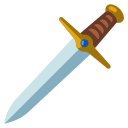
The sword emoji 🗡️ means a sharp, cutting remark — a savage comeback, a clean roast, or "slay." Its official Unicode name is Dagger, but almost nobody uses it literally; in texts it's playful drama, not a threat.
Dagger
Sword Emoji 🗡️
Officially a dagger, used online as the "slay / savage comeback" blade.
🗡️ is the emoji people reach for when a message lands like a blade — a devastating one-liner, a receipt drop, a "cutting someone off" moment. It also carries a huge fantasy/gaming load: RPGs, D&D, anime, medieval and dark-academia aesthetics. Read the surrounding words before you read it as aggression.
✍️ Written & reviewed against real usage · verified Unicode 16.0
Tap to copy · pastes in WhatsApp, Instagram, anywhere
Sword emojis to copy & paste
These are the real emoji characters — tap one to copy it, then paste anywhere. Because they’re text, they show up as emoji wherever you send them.
Sword & related emojis
Sword combos
What the sword emoji means
In practice 🗡️ splits into three uses. First, verbal violence as a compliment: someone says something brutally accurate and you reply "🗡️🗡️" — the emoji equivalent of "that cut deep." Second, aesthetic: fantasy, gaming, anime, knight-core, dark academia, villain-era captions. Third, self-directed drama — "me walking into the group chat 🗡️" — where it signals main-character energy rather than harm. Gen Z rarely uses it to mean literal fighting; that read belongs to older users or to gaming contexts where it just labels a weapon. It's close to 🔪 but reads more theatrical and less unhinged, and close to ⚔️ but singular rather than "battle." Tone almost always comes from the words around it, not the blade itself.
💬
Texting & iMessage
Tacked onto a roast or a screenshot to mean 'that cut.' Between friends it's applause for a good burn, not a threat.
🎵
TikTok
Captions for villain-era, POV and fantasy edits. '🗡️' in a comment usually means the creator destroyed someone in the video.
📸
Instagram & Snapchat
Bio decoration for gaming, anime and knight-core accounts; on Snap it lands as playful menace in a streak reply.
💘
Dating apps
In a bio it flags D&D, fantasy or gaming interests. In chat it's teasing — 'careful 🗡️' is flirting, not a red flag.
💼
Work chat
Avoid it. Even as a joke about 'killing' a deadline, a blade emoji in Slack or email can be screenshotted badly out of context.
See it in real chats
How 🗡️ actually reads in a group chat
she really said "you peaked in year 10" and left
🗡️🗡️ no survivors
i felt that through the screen
putting it on my gravestone 😌🗡️
Q. What does 🗡️ mean from a girl or guy?
From a girl, 🗡️ is usually theatrical, not threatening. Sent after a roast or a screenshot, it means "I ended them" or "that was savage" — she's crowning the comeback, often her own. In flirting it reads as playful menace: "you're lucky you're cute 🗡️," a soft warning wrapped in a joke, closer to teasing than to an actual boundary. It also shows up as pure aesthetic — villain era, fantasy fan, gaming or anime identity in a bio. What it almost never means is genuine anger; real anger usually arrives with plain text and no emoji at all.
🗡️ vs ⚔️ — which one do you actually want?
Dagger (sword emoji) 🗡️ and Crossed swords ⚔️ look closely related and get swapped constantly, but they land differently in a message. Here is what separates them, so you send the one you actually mean.
🗡️
Dagger (sword emoji)
One blade. Personal and pointed — a single savage line, a villain-era caption, an RPG or anime aesthetic. Use it when one person did the cutting.
vs
⚔️
Crossed swords
Two blades. Means conflict, versus, or battle between sides — sports matchups, gaming PvP, debates. Use it when there are two opponents, not one sharp remark.
How 🗡️ looks on every platform
It’s the same character everywhere — each platform just draws it in its own style. Here are three open emoji sets side by side, plus how your own device renders it:
🗡️
Your device
Twitter / X
Google (Noto)
OpenMoji
Platform
How it differs
Apple
Grey blade with an ornate gold crossguard, angled point-up — the version most people picture.
Google
Slimmer silver dagger with a dark handle; reads more like a knife than a sword at small sizes.
Samsung
Curved, decorative blade with a jewelled hilt — closer to a fantasy dagger than a plain weapon.
Microsoft
Flat, minimal grey blade; the least dramatic rendering, easy to miss in a busy message.
WhatsApp
Gold-hilted dagger similar to Apple's, so cross-platform meaning stays stable.
Twitter/X
Simple two-tone dagger pointing up-right; small and easy to confuse with 🔪 on mobile.
Apple, Samsung and WhatsApp draw their own proprietary versions, which we don’t redistribute — the notes above describe how they differ. Open sets shown under their licences: Twemoji (CC-BY 4.0), Noto Emoji (Apache 2.0), OpenMoji (CC BY-SA 4.0).
When 🗡️ backfires
The sword emoji 🗡️ is not always read the way you intend it. These three situations change what 🗡️ signals, and knowing them keeps you from sending the wrong message.
It's officially a dagger, not a sword. If you need 'battle' or 'versus,' ⚔️ is the correct pick and reads far more clearly.
At thumbnail size on Google and Twitter it's easily mistaken for 🔪 — which carries a much more threatening read.
Sent to someone who doesn't know you well, or after a real disagreement, it stops being theatrical and looks like intimidation.
Never use it in work tools, school platforms, or any moderated account. Weapon emoji can trip automated safety filters regardless of intent.
The claim that 🗡️ is a coded gang or drug symbol is a myth — there is no established hidden meaning behind it.
Frequently asked
Quick answers to what people ask most about the sword emoji 🗡️ — what it means in a text, who tends to send it, and how to copy it onto your own keyboard.
What does the 🗡️ emoji mean?
The 🗡️ emoji means a cutting, savage remark — a comeback that landed, a roast, or 'slay.' Its official Unicode name is Dagger. In everyday texting it signals theatrical drama or fantasy aesthetics far more often than literal violence or threat.
What does 🗡️ mean from a girl?
From a girl, 🗡️ usually crowns a savage comeback or sets a playful, villain-era tone. In flirting it's teasing menace — 'you're lucky you're cute 🗡️.' It rarely signals genuine anger, since real anger normally arrives as plain text with no emoji.
Is 🗡️ a sword or a dagger?
Unicode names it Dagger, and most platforms draw a short blade with an ornate hilt. People still search and use it as the sword emoji. If you specifically need swords, ⚔️ Crossed Swords is the closer and clearer choice.
What is the difference between 🗡️ and 🔪?
🗡️ is an ornate dagger and reads theatrical, fantasy-flavoured or sarcastic. 🔪 is a kitchen knife and reads either domestic — cooking, chopping — or genuinely unhinged. 🗡️ is the safer choice for joking about a brutal comeback.
Is it rude to send the 🗡️ emoji?
Between friends it isn't rude; it works as applause for a good burn. It becomes risky with strangers, after a real argument, or in professional and school accounts, where a weapon emoji can read as intimidation or trip moderation filters.
What does 🗡️ mean on TikTok?
On TikTok 🗡️ marks villain-era, POV and fantasy content, and appears in comments when a creator verbally destroys someone. It functions as 'that was savage' or 'slay,' typically stacked as 🗡️🗡️ for emphasis rather than used literally.
How do I type the sword emoji?
Copy 🗡️ from this page, or type :dagger: in Slack and Discord. On iPhone and Android search 'dagger' or 'knife' in the emoji keyboard; on Windows press Win + . and search dagger to insert it.
Related emoji guides
If 🗡️ came up in a conversation, these are the emoji people most often look up next — each one explained the same way, with meanings you can actually use and characters you can copy.