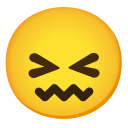
The stressed emoji 😖 is Unicode's confounded face — scrunched, X-shaped mouth, eyes squeezed shut — and it means frustrated, overwhelmed, or fed up rather than sad. Tap or click the emoji above to copy 😖, then paste it anywhere.
Confounded Face
Stressed Emoji 😖
Confounded Face — the "I am at my limit" emoji
😖 is the emoji people reach for when something is not painful, just unbearable. Its official Unicode name is Confounded Face, and on every major platform it renders as a face with eyes clamped shut and a mouth crushed into a tight X or zigzag. That mouth is the whole story: it is a face bracing against something, not crying about it. Search traffic calls it the stressed emoji because that is the feeling it actually carries in messages — deadline stress, admin stress, my-brain-is-full stress. It is the closest thing the standard emoji set has to a groan.
✍️ Written & reviewed against real usage · verified Unicode 16.0
Tap to copy · pastes in WhatsApp, Instagram, anywhere
Stressed emojis to copy & paste
These are the real emoji characters — tap one to copy it, then paste anywhere. Because they’re text, they show up as emoji wherever you send them.
Stressed & related emojis
Stressed combos
What the stressed emoji means
In practice 😖 sits between annoyance and defeat. It says "this is too much and I have no more patience for it," which is why it attaches so naturally to work emails, group projects, revision, parking apps, and family logistics. It is rarely used for grief or genuine bad news — 😢 and 😭 own that. Gen Z uses 😖 mostly self-deprecatingly, as a shrug at their own low tolerance for a task ("opening my banking app 😖"), and often as comic exaggeration rather than a real distress signal. Millennials use it more literally: when they send 😖, they usually mean it, and they usually want a reply. A second layer worth knowing is the cutesy read. Because the scrunched face resembles a squishy cartoon expression, 😖 also works as a soft "nooo stop" — used when someone is flustered by a compliment, embarrassed by a memory, or reacting to something too sweet. Context decides which one you are receiving: if it follows a task, it is stress; if it follows a compliment or a photo, it is fluster.
💼
Work and admin stress
The most common use by far. Attached to Slack pings, expense reports, rescheduled meetings and "quick call?" messages as a groan you can send a coworker without complaining out loud.
🎓
Study and deadline posts
On TikTok and Instagram Stories, 😖 captions revision desks, 3am essay drafts and results-day nerves. It reads as pressure without drama, which is why it beats 😭 for study content.
🫣
Flustered and embarrassed
After a compliment, an old photo, or something too cute, 😖 becomes a soft "stop it." This is the second-biggest use and the one people most often misread as real distress.
🤝
Softening a no
"Can't make Friday 😖" — the emoji does the apologising. It signals genuine regret and takes the sting out of cancelling far better than a bare text does.
😂
Comic exaggeration
Gen Z routinely uses 😖 for tiny inconveniences on purpose — replying to a voice note, standing up, choosing a restaurant — as a joke about their own low tolerance.
See it in real chats
How 😖 actually shows up in a real thread
they moved the deadline to Thursday 😖
no way. do you have to redo the whole deck?
all of it. and I already told my sister I'd drive her Wednesday 😖🚗
send me the last three slides, I'll take them
you're actually saving my life rn 🫠
Q. What does 😖 mean from a girl or guy?
When someone sends 😖, they are telling you they are at capacity — and that they trust you enough to say so without dressing it up. It is a low-stakes vulnerability signal. Unlike 😭, which is performed and often funny, 😖 tends to be honest and a little tired. Sent right after a compliment or a photo, it flips meaning entirely: that is fluster, not stress, and it usually means the message landed. Either way it is an opening. The right move is to ask what happened, not to fire a joke back — 😖 is someone quietly asking to be handled gently for a minute.
😖 vs 😣 — the pair everyone mixes up
Confounded Face 😖 and Persevering Face 😣 look closely related and get swapped constantly, but they land differently in a message. Here is what separates them, so you send the one you actually mean.
😖
Confounded Face
X-shaped or zigzag mouth, eyes screwed shut. Means fed up, frustrated, at your limit. Use it when something has beaten you: broken software, a moved deadline, a fourth phone menu. There is a note of giving up in it.
vs
😣
Persevering Face
Flat closed mouth, angled brows, eyes squeezed but softer. Means straining, enduring, pushing through. Use it when you are still in the fight: last mile of a run, holding a plank, keeping a straight face. There is hope in it.
How 😖 looks on every platform
It’s the same character everywhere — each platform just draws it in its own style. Here are three open emoji sets side by side, plus how your own device renders it:
😖
Your device
Twitter / X
Google (Noto)
OpenMoji
Platform
How it differs
Apple / iMessage
Eyes squeezed into tight closed curves with a wide, crushed X-shaped mouth. The most anguished-looking version, which is why iPhone users read it as genuinely stressed.
Google / Android
Rounder, softer face with a small zigzag mouth. Reads noticeably cuter and less desperate than Apple's — the same message can land as "aww" instead of "help."
Samsung One UI
Follows Google's Noto design closely now; older Samsung builds had a much flatter mouth that some users mistook for a grimace.
WhatsApp
Bright yellow with a bold X mouth and heavy closed-eye lines. Very legible at small sizes, so it stands out in busy group chats.
Twitter / X (Twemoji)
Flat, minimal design with simple arched eyes and a narrow zigzag. Looks mildly annoyed rather than overwhelmed at timeline size.
Snapchat & TikTok
Both render the system emoji, so the same 😖 looks harsher to an iPhone viewer than to an Android one. Do not assume your recipient sees the face you sent.
Apple, Samsung and WhatsApp draw their own proprietary versions, which we don’t redistribute — the notes above describe how they differ. Open sets shown under their licences: Twemoji (CC-BY 4.0), Noto Emoji (Apache 2.0), OpenMoji (CC BY-SA 4.0).
Where 😖 goes wrong
The stressed emoji 😖 is not always read the way you intend it. These three situations change what 😖 signals, and knowing them keeps you from sending the wrong message.
It is constantly confused with 😣 persevering face. 😖 has an X or zigzag mouth (frustration); 😣 has a flat straining mouth and visible brows (enduring something). Swapping them turns "I'm fed up" into "I'm holding on."
Cross-platform drift is real. Apple's 😖 looks close to agony while Google's looks almost cute, so a mild groan can land as a crisis, or vice versa. Let your words carry the tone, not the glyph.
It can read passive-aggressive when replying to a request. "Sure, I'll do it 😖" is not agreement, it is a complaint with a smiley on it. If you actually mind, say so in words; if you don't, drop the emoji.
It is not a sadness emoji, despite what a lot of listicles claim. 😖 carries no tears and no grief. Using it in response to someone's genuine bad news reads as inconvenienced rather than sympathetic — 😢 or 🫂 are the right calls.
Avoid it in professional writing to anyone senior, in customer-facing replies, and in dating-app openers. At work it signals you cannot handle the workload; in a first message it front-loads negativity before anyone knows you.
Frequently asked
Quick answers to what people ask most about the stressed emoji 😖 — what it means in a text, who tends to send it, and how to copy it onto your own keyboard.
What does the 😖 emoji mean?
😖 means frustrated, overwhelmed or fed up. Its Unicode name is Confounded Face, and the squeezed eyes with an X-shaped mouth signal that someone has hit their limit with a task or situation — not that they are sad or crying.
Is 😖 the stressed emoji?
Yes, informally. There is no emoji officially named "stressed," so 😖 confounded face has become the default stand-in, alongside 😫 tired face and 😩 weary face. 😖 specifically conveys frustration-stress rather than exhaustion.
What is the difference between 😖 and 😣?
😖 confounded face has an X or zigzag mouth and means frustration or being fed up. 😣 persevering face has a flat closed mouth and raised brows and means enduring something difficult. 😖 gives up; 😣 keeps going.
How do I copy and paste 😖?
Tap or click the large 😖 at the top of this page to copy it, then long-press and choose Paste on mobile, or press Ctrl+V on Windows or Cmd+V on Mac. It works in any app that accepts text.
Does 😖 mean someone is flirting?
Not by itself. But when 😖 follows a compliment, a selfie or something affectionate, it reads as flustered — a soft "stop it, you're embarrassing me." After a task or a complaint, it is plain stress. Context decides.
Is 😖 a Gen Z emoji?
Gen Z uses it heavily but ironically, for tiny inconveniences, as a joke about low tolerance. Older users tend to mean it literally. If a younger friend sends 😖 about something trivial, it is comedy, not a distress call.
What should I send back to 😖?
Ask what happened, or mirror it. 🫂 and 😮💨 acknowledge the stress, 😖 back says "same," and ☕ or 🛌 read as "go take a break." Avoid 😂 unless you are certain they are joking.
Related emoji guides
If 😖 came up in a conversation, these are the emoji people most often look up next — each one explained the same way, with meanings you can actually use and characters you can copy.