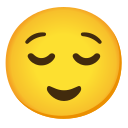
The relieved emoji 😌 shows a face with closed eyes and a small, gentle smile, meaning calm, contentment, or relief after stress. In everyday texting it more often signals quiet satisfaction or mild smugness — the feeling of being right, at peace, or completely unbothered.
😌
Relieved Emoji 😌
Relieved Face · U+1F60C · closed eyes, faint smile — the softest flex on the keyboard
Tap the big 😌 above to copy it — it pastes as a real Unicode character (U+1F60C, Relieved Face), so it works in iMessage, WhatsApp, Instagram captions, TikTok comments, Discord, Slack, Google Docs and anywhere else text goes. No image, no download, no app. On desktop, Win + . (Windows) or Control + Command + Space (Mac) opens the emoji picker; search "relieved" and it's the first hit.
✍️ Written & reviewed against real usage · verified Unicode 16.0
Tap to copy · pastes in WhatsApp, Instagram, anywhere
Relieved emojis to copy & paste
These are the real emoji characters — tap one to copy it, then paste anywhere. Because they’re text, they show up as emoji wherever you send them.
Relieved & related emojis
Relieved combos
What the relieved emoji means
Officially 😌 is relief — the exhale after the exam ends, the test comes back negative, the flight lands. But the way people actually use it drifted years ago. Because the eyes are closed and the smile is small and closed-mouth, 😌 reads as serene rather than excited, and serenity placed next to a brag becomes a flex. "Passed with a 98 😌" is not relief; it's a victory lap delivered in a whisper. That's the dominant read now: unbothered, self-satisfied, above it all. A second common use is the soft-close — dropping 😌 at the end of a message so it lands gently, the emoji equivalent of a shrug and a smile. A third is genuine peace: "finally in bed 😌", "coffee, no meetings, no notifications 😌". Context does all the work. A bragging clause before it means smug. A stressful situation resolved before it means actual relief. Nothing before it means you're being cozy or you're being dry, and the reader will guess from your tone history.
📱
TikTok comments
The closing beat on a self-satisfied take: "knew this would age well 😌". Also standard in "POV: you finally set boundaries 😌" captions, where it means restored peace rather than relief.
👻
Snapchat
Common on cozy or petty snaps — a made bed, a blocked contact, a clean skin day. Low urgency: a 😌 on a black screen usually just means "goodnight, nothing's wrong."
💬
iMessage & group chats
Softens a firm statement. "I'm not going 😌" is a polite refusal, not a sulk. Millennials tend to read it literally as relief; Gen Z reads smug or serene first.
💘
Dating apps
A low-key confidence signal. "Yeah I cook 😌" is a flex framed as modesty. It isn't a flirt emoji on its own — it's a composure emoji, so pair it with something warmer if you want heat.
💼
Work Slack
Safe on a shipped-it message ("deploy's green 😌"). Risky mid-disagreement, where the calm face reads as condescension. Use 🙂 or nothing when tensions are high.
See it in real chats
How it actually lands in a chat
how'd the interview go?? were you nervous
got the offer 😌
OF COURSE you did. the calm face is so smug lol
i contain multitudes. also i genuinely have not slept in 3 days 😮💨😌
Q. What does 😌 mean from a girl or guy?
😌 says more about the sender than about you, and what it says is "I'm fine, actually." It's a composure emoji — someone using it is signalling they're calm, in control, and not going to chase the conversation. When it follows a compliment they paid themselves, it's playful smugness. When it follows something you did, it can read as gently approving or gently patronising depending on how warm the rest of the message is. And when it arrives alone after you've explained yourself at length, treat it as a soft full stop: they've heard you, they're not arguing, and they're also not asking a follow-up question.
😌 vs 😔 — the mix-up everyone arrives with
Relieved Face 😌 and Pensive Face 😔 look closely related and get swapped constantly, but they land differently in a message. Here is what separates them, so you send the one you actually mean.
😌
Relieved Face
Closed eyes with a small upward-curving closed smile. Means content, calm, relieved — and in modern texting, quietly smug. Positive tone.
vs
😔
Pensive Face
Same closed downcast eyes, but the mouth curves down. Means sad, disappointed, wistful. Negative tone. If the mouth frowns, it is not the relieved emoji.
How 😌 looks on every platform
It’s the same character everywhere — each platform just draws it in its own style. Here are three open emoji sets side by side, plus how your own device renders it:
😌
Your device
Twitter / X
Google (Noto)
OpenMoji
Platform
How it differs
Apple
Warm yellow face, closed curved eyes, small closed smile. This is the reference look most people picture when they say "relieved emoji".
Google (Noto)
Flatter smile and thinner eye curves — noticeably closer to 😔 at comment size, which is the main source of misreads.
Samsung
Rounder face with a slightly wider grin; reads happier and less smug than Apple's version.
Microsoft (Fluent)
Softer 3D shading and more downward eye tilt, so it can look sleepy rather than content.
WhatsApp
Very close to Apple's rendering with a marginally flatter smile — tone survives cross-platform intact.
X / Twemoji
Flat, simplified, minimal eye curve; often mistaken for a plain closed-eye smile with none of the smugness.
Apple, Samsung and WhatsApp draw their own proprietary versions, which we don’t redistribute — the notes above describe how they differ. Open sets shown under their licences: Twemoji (CC-BY 4.0), Noto Emoji (Apache 2.0), OpenMoji (CC BY-SA 4.0).
Where 😌 goes wrong
The relieved emoji 😌 is not always read the way you intend it. These three situations change what 😌 signals, and knowing them keeps you from sending the wrong message.
The biggest misread is 😌 versus 😔. Both have closed downcast eyes and only the mouth differs, so on Google and Twemoji at small sizes some readers see sadness where you meant contentment. When it matters, write the feeling out.
It reads passive-aggressive in conflict. Replying 😌 to someone who is upset says "I'm calm and you aren't," which escalates instead of defusing. Never use it to end an argument.
Sarcasm layer: "great, another meeting 😌" is a standard dry-tone move now. To a reader who doesn't know your tone, that same message lands as sincere enthusiasm — the exact opposite of your meaning.
Myth check: 😌 does not mean sleepy, high, or sexual. Those reads get projected onto it because the eyes are closed, but no established usage backs them — 😴 and 😏 carry those meanings.
Overuse turns it into a verbal tic. Ending every message with 😌 flattens your tone and starts reading as smug by default, which is the impression most senders are trying to avoid.
Frequently asked
Quick answers to what people ask most about the relieved emoji 😌 — what it means in a text, who tends to send it, and how to copy it onto your own keyboard.
How do I copy the relieved emoji?
Tap or click the 😌 at the top of this page and it copies to your clipboard as plain Unicode text. Paste it into texts, captions, bios or documents. On Windows press Win + . and on Mac press Control + Command + Space, then search "relieved".
What does 😌 mean when someone sends it to you?
Usually composure, not romance. It signals the sender is calm, satisfied, or quietly pleased with themselves. After a brag it's playful smugness; after a resolved problem it's genuine relief; alone at the end of a message it's a soft full stop meaning "I'm done talking, and I'm fine."
Is 😌 the same as 😔?
No. 😌 Relieved Face has a small upward smile and means contentment. 😔 Pensive Face has a downturned mouth and means sadness or disappointment. Their eyes look nearly identical on several platforms, which is why the two get confused constantly.
Does 😌 mean someone is annoyed?
Not by itself, but it can. Sent mid-disagreement, the serene face reads as "I'm above this" and comes across as condescending. Sent after good news or a cozy update, it's completely neutral and warm.
What is the Unicode codepoint for 😌?
U+1F60C, named Relieved Face. It was added in Unicode 6.0 in 2010 and included in Emoji 1.0 in 2015. The shortcode on Slack, Discord and GitHub is :relieved:.
Is 😌 a Gen Z emoji?
It's used across generations, but the reading differs. Millennials skew literal — relief, calm, gratitude. Gen Z skews ironic — smug, unbothered, "told you so" energy, usually as the final character in a flex or a dry-humour post.
When should I not use 😌?
Avoid it in arguments, in apologies, and in serious work threads where someone is stressed. The calm expression clashes with urgency and reads as dismissive. Use plain words, or 🙂 if you need something light.
Related emoji guides
If 😌 came up in a conversation, these are the emoji people most often look up next — each one explained the same way, with meanings you can actually use and characters you can copy.