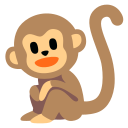
The monkey emoji 🐒 usually means playful mischief — being silly, hyper, or a little menace. It rarely means an actual monkey. People send it to soften teasing, call someone a goofball, or label their own chaotic behavior.
U+1F412
Monkey Emoji 🐒
Full-body monkey 🐒 — the "you're being a little menace" emoji
🐒 means playful mischief. It marks someone as silly, hyper or annoying-in-a-cute-way, softens teasing so it reads as affectionate, and tags chaotic behavior. Literal monkey use is rare outside zoo, travel and animal posts.
✍️ Written & reviewed against real usage · verified Unicode 16.0
Tap to copy · pastes in WhatsApp, Instagram, anywhere
Monkey emojis to copy & paste
These are the real emoji characters — tap one to copy it, then paste anywhere. Because they’re text, they show up as emoji wherever you send them.
Monkey & related emojis
Monkey combos
What the monkey emoji means
🐒 is the full-body monkey, and online it does social work, not zoology. Its core meaning is playful mischief: the person is messing around, climbing the walls, or doing something dumb on purpose. That is why it lands most often at the end of a sentence, as a tone tag — "stop 🐒" reads as amused, not annoyed. A second common use is self-labelling: people call themselves a monkey when they are being hyper, feral, snack-obsessed or running on no sleep, which is the whole "monkey brain" and "feral little guy" energy that took over TikTok comments. Third, it is a soft insult between friends — closer to "goofball" than anything harsh, and it is why it pairs so naturally with 🍌 and 😭. Note the one hard rule: because monkey and ape imagery has a long racist history, 🐒 aimed at a specific person's appearance, hair or intelligence reads as a slur, not a joke. Between friends about behavior it is fine; about a person's looks or race it is never fine. The literal readings — zoo trips, Thailand and Bali travel posts, Year of the Monkey, Curious George, gym "monkey bars" — still exist, but they are the minority of everyday sends.
💬
In texts
Tone-softener at the end of teasing. "you're such a 🐒" = goofball, said with affection, not an actual insult.
📱
In DMs
Self-tag for hyper or chaotic energy — "i've had 3 coffees 🐒". Also flirty-silly when someone is being annoying on purpose.
🎵
On TikTok
Comment shorthand for feral behavior and "monkey brain" impulse content — snack raids, no-sleep posting, unhinged edits.
🌍
Literal use
Zoo trips, Bali and Thailand travel posts, Year of the Monkey, monkey bars at the gym, and pet-like nicknames for toddlers.
Q. What does 🐒 mean from a girl or guy?
From a girl, 🐒 is almost always playful, not romantic. Sent about you — "you're a 🐒", "stoppp 🐒" — it means she finds you funny and a little ridiculous, and she is comfortable enough to tease you. That is a good sign socially, but it is friend-zone-neutral: it signals ease, not attraction, so do not read flirting into it on its own. Sent about herself — "i ate the whole bag 🐒", "running on 4 hours sleep 🐒" — she is calling herself chaotic or hyper and inviting you to laugh with her; matching her energy back beats complimenting her. The one time it is not playful: if the conversation was already tense, a lone 🐒 can be a dismissive "you're being an idiot." Read the message before it, not the emoji alone. And never use it back to describe how someone looks.
🐒 vs 🐵 — which monkey do people actually send?
Monkey 🐒 and Monkey Face 🐵 look closely related and get swapped constantly, but they land differently in a message. Here is what separates them, so you send the one you actually mean.
🐒
Monkey
Full-body monkey with a tail. Used for behavior — someone acting wild, hyper, mischievous or climbing-the-walls chaotic.
vs
🐵
Monkey Face
Head only. Used as a reaction face — cheeky, cute, a bit sheepish. It is the one people default to when they just want a mood, not an action.
How 🐒 looks on every platform
It’s the same character everywhere — each platform just draws it in its own style. Here are three open emoji sets side by side, plus how your own device renders it:
🐒
Your device
Twitter / X
Google (Noto)
OpenMoji
Platform
How it differs
Apple
A brown macaque-style monkey standing in profile with a long curled tail and pale face.
Google
Lighter brown cartoon monkey facing forward, sitting with a visible tail curled to one side.
Samsung
Rounder, more toy-like monkey with a tan belly and large eyes — reads younger and cuter.
WhatsApp
Simple side-facing brown monkey; small at chat size, easy to mistake for 🐵 monkey face.
Microsoft/X
Flatter, more stylized monkey; on X the tail is thin and can vanish at comment size.
Apple, Samsung and WhatsApp draw their own proprietary versions, which we don’t redistribute — the notes above describe how they differ. Open sets shown under their licences: Twemoji (CC-BY 4.0), Noto Emoji (Apache 2.0), OpenMoji (CC BY-SA 4.0).
When 🐒 backfires
The monkey emoji 🐒 is not always read the way you intend it. These three situations change what 🐒 signals, and knowing them keeps you from sending the wrong message.
Racist read. Monkey and ape imagery has a documented history as a racial slur. Aimed at a person's looks, hair or intelligence, 🐒 is not a joke — it is a slur, regardless of intent.
Too small to read. At comment size 🐒 and 🐵 look nearly identical on most platforms, so the "full body" nuance you meant is usually lost.
Reads childish at work. In a Slack thread or a client reply, 🐒 lands as immature rather than funny — 😅 or 🙈 does the same softening with less risk.
Frequently asked
Quick answers to what people ask most about the monkey emoji 🐒 — what it means in a text, who tends to send it, and how to copy it onto your own keyboard.
What does the monkey emoji 🐒 mean from a guy?
Usually the same as from anyone else: he is teasing you or calling himself chaotic. Guys often use it to soften a jab so it reads as banter, or to tag hyper, sleep-deprived, snack-raiding behavior. It is playful and rarely flirty on its own.
Is the monkey emoji flirty?
Not by default. It signals comfort and silliness rather than attraction. It can become flirty in a teasing back-and-forth, but if it arrives alone with no other flirty signals, treat it as friendly.
What is the difference between 🐒 and 🐵?
🐒 is the full-body Monkey and is used for actions and behavior. 🐵 is Monkey Face, a head-only reaction emoji used for cheeky or sheepish moods. At small sizes they look similar, and many people use them interchangeably.
Is it offensive to send the monkey emoji to someone?
It depends entirely on target. About behavior between friends it is harmless. Directed at a specific person's appearance, race, hair or intelligence it reads as a racial slur, because monkey and ape imagery has been used that way historically. Avoid it there completely.
What does 🙈 mean compared to 🐒?
🙈 is the See-No-Evil Monkey and means embarrassment, cringe or covering your eyes at something awkward. 🐒 means mischief and chaotic energy. They come from the same family but do different jobs.
When was the monkey emoji added?
🐒 was added in Unicode 6.0 in 2010 and included in Emoji 1.0. Its codepoint is U+1F412 and its shortcode is :monkey:, so it works on essentially every modern phone and platform.
Related emoji guides
If 🐒 came up in a conversation, these are the emoji people most often look up next — each one explained the same way, with meanings you can actually use and characters you can copy.