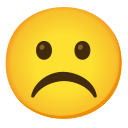
The frown emoji ☹️ means mild sadness, disappointment or displeasure. It shows a face with a downturned mouth and is used to react to bad news, a cancelled plan or a small letdown — softer than 😢 crying and less dramatic than 😭.
Frowning Face
Frown Emoji ☹️
The outlined frowning face — quieter, older and more passive-aggressive than 🙁 or 😢.
☹️ Frowning Face is the text-symbol frown that predates the yellow emoji set, which is why it renders flat and outlined on many keyboards instead of glossy yellow. That older look gives it a deadpan, understated tone: it signals "that's a bummer" rather than real grief. Most people reach for it for small disappointments — a rain forecast, a sold-out ticket, a plan falling through.
✍️ Written & reviewed against real usage · verified Unicode 16.0
Tap to copy · pastes in WhatsApp, Instagram, anywhere
Frown emojis to copy & paste
These are the real emoji characters — tap one to copy it, then paste anywhere. Because they’re text, they show up as emoji wherever you send them.
Frown & related emojis
Frown combos
What the frown emoji means
☹️ carries low-intensity unhappiness. It is the emoji equivalent of a sigh: disappointed, let down, slightly bothered, but not crying and not angry. Because it is one of the few faces that isn't filled yellow on Apple, Samsung and Windows, it reads as older and more formal — millennials and Gen X use it far more than Gen Z, who default to 🙁, 😔 or the ironic 💔. In practice it appears in three places: reacting to news you can't change ("flight delayed ☹️"), softening your own bad news so it doesn't sound like a complaint ("can't make Friday ☹️"), and quiet passive aggression, where the frown does the criticising so the words don't have to. Gen Z often reads a lone ☹️ from a parent or boss as genuine displeasure, because unlike 😭 it is almost never used as a joke.
💬
iMessage & WhatsApp
Tacked onto your own cancellation to sound regretful rather than flaky. On iMessage it renders as a flat black-outline face, which many people mistake for a broken glyph the first time they see it.
📱
Snapchat & DMs
Used as a low-effort reaction to a friend's bad news — enough to acknowledge it without writing a paragraph. Sent with no text after an argument, it usually means 'I'm still upset' rather than 'I'm sad'.
🎵
TikTok comments
Rare from teens, common from older commenters. When Gen Z does use it, it's deliberately old-fashioned — mimicking a parent, a boomer caption or a 2013 Facebook status for comedic effect.
💘
Dating apps
Shows up in soft rejections and reschedules ('this week's mad busy ☹️'). Reads as sincere and slightly formal, which is why it lands better than 🙃 when you actually mean it — and worse when you're joking.
💼
Work chat
The safest sad face in Slack or Teams because it isn't melodramatic. Fine for 'missed the deadline ☹️' with peers, but avoid it as a reaction to a colleague's work — an outlined frown on a deliverable reads as a verdict.
See it in real chats
How it actually lands in a text
hey so the venue just cancelled on us for saturday ☹️
nooo are you serious
yeah they double booked. trying to find somewhere else but everywhere decent is gone
ok give me an hour, my friend works at that place on King St 🫡
you're a lifesaver honestly 🫂
Q. What does ☹️ mean from a girl or guy?
From a girl, ☹️ almost always means mildly hurt rather than angry. It shows up when plans get cancelled, when a reply came hours late, or when she wants you to notice something is off without starting an argument — it's an invitation to ask, not a shutdown. Context decides the weight: attached to her own news ("can't come tonight ☹️") it is apology and genuine regret. Sent alone, with no words, after something you said, it is a soft flag that you missed a cue. It is rarely flirty and almost never sarcastic, which is exactly what separates it from 🥺 or 😔.
☹️ vs 🙁 — which frown are you actually sending?
Frowning Face ☹️ and Slightly Frowning Face 🙁 look closely related and get swapped constantly, but they land differently in a message. Here is what separates them, so you send the one you actually mean.
☹️
Frowning Face
The 1993 text symbol. Deeper frown, and on Apple it renders as a bare black outline with no yellow fill. Reads older, flatter and more serious — closer to real displeasure. Good for sincere disappointment, risky as sarcasm.
vs
🙁
Slightly Frowning Face
Added in Emoji 1.0 and always drawn as a filled yellow face with a shallow frown. Reads lighter and more casual — 'eh, shame' rather than 'I'm upset'. The safer default for minor letdowns and group chats.
How ☹️ looks on every platform
It’s the same character everywhere — each platform just draws it in its own style. Here are three open emoji sets side by side, plus how your own device renders it:
☹️
Your device
Twitter / X
Google (Noto)
OpenMoji
Platform
How it differs
Apple
Black outline on white with a downturned mouth — no yellow fill. The starkest, most 'symbol-like' version, which is why it reads colder than other sad faces.
Google
Noto shows a filled yellow face with flat, slightly angled brows, making it look closer to annoyed than sad and warmer than Apple's outline.
Samsung
Yellow face with a pronounced curved frown and neutral brows; noticeably sadder and more sympathetic than the Apple rendering.
Microsoft
Yellow with a deep frown and lowered brows on Windows; on older builds it appeared black-and-white, so screenshots vary a lot by Windows version.
WhatsApp
Yellow face with small dot eyes and a wide downturned mouth — mild and cartoonish, easily confused with 🙁 at message size.
Twitter
Twemoji renders a flat yellow circle with a simple curved frown, the least expressive version; a lot of nuance is lost on X and Discord.
Apple, Samsung and WhatsApp draw their own proprietary versions, which we don’t redistribute — the notes above describe how they differ. Open sets shown under their licences: Twemoji (CC-BY 4.0), Noto Emoji (Apache 2.0), OpenMoji (CC BY-SA 4.0).
When ☹️ backfires
The frown emoji ☹️ is not always read the way you intend it. These three situations change what ☹️ signals, and knowing them keeps you from sending the wrong message.
On Apple devices it renders as a flat black-and-white outline, not a yellow face. People regularly assume it's a broken or missing emoji, or that you sent a deliberately cold 'text symbol' instead of a real reaction.
☹️ and 🙁 are two different codepoints that look nearly identical at message size. Nobody can reliably tell which one you sent, so any tone difference you intend between them will be lost.
Sent alone with no words, it is read as passive aggression far more often than as sadness — it makes the other person guess what's wrong, which escalates arguments rather than defusing them.
It is not an irony emoji. Unlike 😭 or 💀, ☹️ has no comedic register with Gen Z, so using it as a joke usually just lands as genuinely sad or as an out-of-touch older person's texting style.
Avoid it as a manager or in customer replies. Because it's unfilled and stark on iOS, an outlined frown attached to someone's work or request reads as disapproval, not empathy.
Frequently asked
Quick answers to what people ask most about the frown emoji ☹️ — what it means in a text, who tends to send it, and how to copy it onto your own keyboard.
What does the ☹️ frown emoji mean?
☹️ means mild sadness, disappointment or displeasure. It shows a face with a downturned mouth and is used for small letdowns — a cancelled plan, bad weather, unwelcome news — rather than real grief, which people mark with 😢 or 😭 instead.
What does ☹️ mean from a girl?
From a girl, ☹️ usually means mildly hurt or disappointed rather than angry. Attached to her own news it's genuine regret and apology. Sent alone after something you said, it's a soft signal that you missed a cue and she wants you to ask.
Why is the frown emoji black and white?
☹️ dates back to Unicode 1.1 in 1993, long before the yellow emoji set, so it defaults to text presentation. Apple and older Windows builds still draw it as a black outline, while Google, Samsung and WhatsApp fill it in yellow.
What's the difference between ☹️ and 🙁?
🙁 Slightly Frowning Face is the milder, always-yellow version added in Emoji 1.0. ☹️ Frowning Face is the older text symbol with a deeper frown that renders as an outline on Apple. At message size they look almost identical.
Is ☹️ passive-aggressive?
It can be. Sent alone with no explanation, especially after a disagreement, ☹️ makes the other person guess what's wrong and reads as a complaint. Paired with words that say what you mean, it reads as sincere and softening instead.
Do Gen Z use the frown emoji?
Rarely and mostly ironically. Gen Z defaults to 🙁, 😔 or 💔 for genuine sadness and 😭 for exaggeration. A plain ☹️ reads as older, more formal texting — often used to imitate a parent or an outdated Facebook caption.
How do I type ☹️ on my phone?
Search 'frown' or 'frowning' in the iOS or Android emoji keyboard, or copy ☹️ directly. On Windows press Win + period and search 'frowning'. On Slack type :white_frowning_face: and on Discord type :frowning2:.
Related emoji guides
If ☹️ came up in a conversation, these are the emoji people most often look up next — each one explained the same way, with meanings you can actually use and characters you can copy.