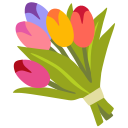
💐 is the bouquet emoji: a wrapped bunch of mixed flowers used to say congratulations, thank you, well done, get well soon, or I'm thinking of you. It reads as a gift being handed over, not as a single flower you found.
Bouquet
Flower Emoji 💐
Tap to copy the bouquet 💐, then see how people actually use it on iMessage, TikTok and Snapchat in 2026.
Copy 💐 above and paste it anywhere — texts, captions, bios, usernames, spreadsheets. The name is "bouquet" (U+1F490), and that wrapping is the whole point: 💐 signals an occasion. People send it for promotions, exam results, opening nights, recitals, retirements, birthdays, Mother's Day, and condolences. On dating apps it's warmer and less loaded than 🌹, which is why a lot of people reach for it on a good second date instead. Gen Z also uses it as a soft applause emoji — a way to say "you did that" without a caps-lock paragraph.
✍️ Written & reviewed against real usage · verified Unicode 16.0
Tap to copy · pastes in WhatsApp, Instagram, anywhere
Flower emojis to copy & paste
These are the real emoji characters — tap one to copy it, then paste anywhere. Because they’re text, they show up as emoji wherever you send them.
Flower & related emojis
Flower combos
What the flower emoji means
The core meaning of 💐 is honoring someone. It marks a moment: a milestone reached, a favor repaid, a loss acknowledged. That's what separates it from every single-stem flower emoji — 🌷 or 🌸 are decorative and can just mean "spring" or "pretty," while 💐 almost always has a recipient. Millennials mostly use it sincerely, at the end of a congratulations text or under a graduation post. Gen Z stretched it two ways: as ironic applause ("she finally answered her emails 💐") and as a soft-close on a sad message, where a bouquet is easier to type than a feeling. On group chats it functions as an emoji reaction for good news — one 💐 from three people is the modern round of applause. In caption use, 💐 tends to soften self-promotion: posting your own win with a bouquet reads as gratitude rather than bragging, which is why you see it under "new role" and "thesis submitted" posts constantly.
🎓
Milestone posts
Graduations, promotions, first days. 💐 in a caption turns a brag into a thank-you note.
💬
Group chat applause
Three people dropping 💐 on someone's good news is 2026's version of a round of applause.
🕊️
Condolences
When words feel wrong, 💐 stands in for flowers you'd send. Pair it with 🤍, never with 🎉.
😐
Ironic praise
"Congrats on doing the bare minimum 💐" — Gen Z's sarcastic clap. Tone lives in the sentence, not the emoji.
🤝
Soft apology
Sent alone after a disagreement, 💐 is a peace offering that avoids saying sorry out loud.
See it in real chats
How it lands in a real thread
i got the job 😭
WHAT 💐💐 you literally said the interview went badly
i lied to protect my ego. starts the 4th
bringing you real ones on the 4th then 💐💼
Q. What does 💐 mean from a girl or guy?
Getting a 💐 usually says more about the sender than about romance. It means they clocked that something mattered to you and wanted to mark it — a bouquet is a gesture, not a flirt. From a friend it's genuine congratulations. From a guy you're talking to, it's warmer and safer than 🌹: he's being sweet without declaring anything, which is often deliberate. From a coworker or acquaintance it's polite goodwill, full stop. The one read to watch is a lone 💐 after an argument — that's an apology someone didn't want to type out loud.
💐 vs 🌹 — the mix-up everyone arrives with
Bouquet 💐 and Rose 🌹 look closely related and get swapped constantly, but they land differently in a message. Here is what separates them, so you send the one you actually mean.
💐
Bouquet
A wrapped bunch of mixed flowers. Means congratulations, thanks, sympathy, or celebration. Occasion-driven and safe to send to a boss, a friend, or your mum. Neutral on romance.
vs
🌹
Rose
A single red rose. Means love, desire, longing, or theatrical drama. Sending it to a coworker reads as a pass; sending it after a fight reads as begging. Never a neutral choice.
How 💐 looks on every platform
It’s the same character everywhere — each platform just draws it in its own style. Here are three open emoji sets side by side, plus how your own device renders it:
💐
Your device
Twitter / X
Google (Noto)
OpenMoji
Platform
How it differs
Apple / iMessage
Pink, purple and blue blooms in brown paper wrap — the version most people picture when they think 'flower emoji'.
Google / Android
Flatter, brighter bunch with visible green stems and no paper cone; reads slightly more like loose flowers.
Samsung
Tighter, rounder posy with a ribbon; at small sizes it can be mistaken for a single flower head.
WhatsApp
Uses its own bouquet art — noticeably more saturated pink than the Apple version in the same thread.
Twitter / X
Simplified three-tone bunch that shrinks poorly in timeline text; details vanish below 16px.
Microsoft / Teams
Angular, illustrative wrap with cooler colors; in work chats it reads formal, closer to a delivered gift.
Apple, Samsung and WhatsApp draw their own proprietary versions, which we don’t redistribute — the notes above describe how they differ. Open sets shown under their licences: Twemoji (CC-BY 4.0), Noto Emoji (Apache 2.0), OpenMoji (CC BY-SA 4.0).
Where 💐 goes wrong
The flower emoji 💐 is not always read the way you intend it. These three situations change what 💐 signals, and knowing them keeps you from sending the wrong message.
It is not a romance emoji by default. Sending 💐 to signal attraction often lands as friendly congratulations instead — if you mean flirtation, 🌹 or plain words do the job better.
Sarcasm risk is real. Because 💐 got adopted as ironic applause, a genuine 'congrats 💐' to someone under 25 can read as mocking. Add a real sentence so tone can't drift.
It flattens at small sizes. On Samsung and Twitter the bouquet collapses into a blob and gets misread as 🌷 or 🌸 in usernames, bios and small caption text.
Wrong context, wrong signal. 💐 carries funeral connotations for many people, so dropping it into a casual thread about nothing can read as ominous or passive-aggressive.
Myth check: 💐 has no hidden drug, sexual, or 'secret dating app' meaning, and no skin-tone variants. Any list claiming otherwise is padding — it means flowers you'd hand someone.
Frequently asked
Quick answers to what people ask most about the flower emoji 💐 — what it means in a text, who tends to send it, and how to copy it onto your own keyboard.
What does 💐 mean in a text?
Congratulations, thank you, or I'm thinking of you. It represents handing someone a bouquet, so it almost always points at an occasion — a win, a favor, a loss, or a birthday.
Is 💐 flirty?
Only mildly, and only in context. On its own it reads as warm goodwill. It's the emoji people pick when they want to be sweet without committing to romance the way 🌹 does.
What's the difference between 💐 and 🌹?
💐 is a wrapped bunch of mixed flowers and means celebration or gratitude. 🌹 is one red rose and means love, desire, or drama. Same category, very different message.
Is 💐 appropriate for condolences?
Yes — it's one of the most-used sympathy emojis, standing in for flowers you'd send. Pair it with 🤍 or 🕊️ and keep celebratory emojis like 🎉 out of the same message.
How do I type 💐 on my phone?
Copy it from this page, or open your emoji keyboard and search 'bouquet' or 'flower'. On Windows press Win + . and on Mac press Control + Command + Space.
Does 💐 have skin tone options?
No. It's a plant emoji with no human element, so there are no Fitzpatrick modifiers and it renders identically for everyone on the same platform.
Why does 💐 look different on Android and iPhone?
Each vendor draws its own artwork. Apple uses a paper-wrapped bunch, Google uses stems with no wrap, and Samsung uses a ribboned posy — same codepoint, three different pictures.
Related emoji guides
If 💐 came up in a conversation, these are the emoji people most often look up next — each one explained the same way, with meanings you can actually use and characters you can copy.